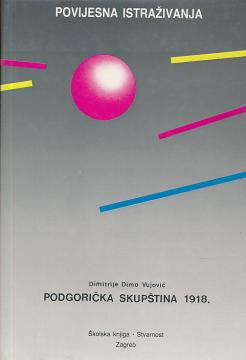
Podgorička skupština 1918.

Podgorička skupština 1918.

Dimitrije Dimo Vujović

The author's goal was to present the events as they were, looking at them not through the prism of today's current political beliefs, but through the prism of documents.

The Great National Assembly of the Serbian People in Montenegro, better known under the abbreviated name Podgorica Assembly, was an assembly with a special purpose in the Kingdom of Montenegro that sat from November 24 to November 29, 1918, after the end of the First World War. On November 26, 1918, decisions were made on the overthrow of the Montenegrin dynasty of Petrović Njegoš in favor of the Serbian dynasty of Karađorđević and the unification, i.e. the annexation of the Kingdom of Montenegro to the Kingdom of Serbia.

Graphics design
Miroslav Rafaj
Dimensions
24 x 17 cm
Pages
287
Publisher
Školska knjiga, Zagreb, 1989.
 
Distribution: 2,000 copies
 
Latin alphabet. Hardcover with dust jacket.
Language: Croatian.

No copies available

The last copy was sold recently.
 

Are you interested in another book? You can search the offer using our search engine or browse books by category.

You may also be interested in these titles

Historija porodice Alibegović: transformacija iz begovske zemljoposjedničke u modernu građansku porodicu

Historija porodice Alibegović: transformacija iz begovske zemljoposjedničke u modernu građansku porodicu

Husnija Kamberović

The book depicts the development of a Bosnian bey family that, throughout the 19th and 20th centuries, transformed from a landowning family into a modern bourgeois family, reflecting broader social changes in Bosnia and Herzegovina.

Udruženje za modernu historiju (UMHIS), 2021.
Croatian. Latin alphabet. Paperback.
18.52
Nacionalno pitanje

Nacionalno pitanje

Omladinski otsek Polit, 1946.
Serbian. Latin alphabet. Paperback.
28.9626.06
Teror narodu: Povijest OZNE, Titove političke policije

Teror narodu: Povijest OZNE, Titove političke policije

William Klinger

In the book, historian William Klinger investigates the origin and operation of OZNA - the brutal repressive apparatus of communist Yugoslavia, which monitored, imprisoned and liquidated political opponents.

Večernji list, 2014.
Croatian. Latin alphabet. Paperback.
7.34
Titostalgija

Titostalgija

Mitja Velikonja

The author explores why Tito remains a popular symbol of stability, social security and independence, despite critical views of his regime. The book maps the cultural, political and everyday manifestations of "Titostalgia".

Biblioteka XX vek, 2010.
Serbian. Latin alphabet. Paperback.
7.36
Snažan eho brionski: Odjeci Brionskog plenuma u Bosni i Hercegovini 1966. godine

Snažan eho brionski: Odjeci Brionskog plenuma u Bosni i Hercegovini 1966. godine

Amir Duranović

Amir Duranović's book reconstructs in detail the dramatic year 1966 and the Fourth (Brion) Session of the Central Committee of the Communist Party of Yugoslavia (July 1–2, 1966), at which Aleksandar Ranković, the long-time head of the UDB and vice preside

Udruženje za modernu historiju (UMHIS), 2017.
Croatian. Latin alphabet. Paperback.
9.54
Nacionalni testament kralja Aleksandra I

Nacionalni testament kralja Aleksandra I

Branislav M. Stepanović

The author presents the political and ideological legacy of King Aleksandar I Karađorđević the Unifier. The book, published immediately after the king's death, is an attempt to preserve and transmit his political ideals to future generations.

Jugoslovenska biblioteka "Bratstvo", 1936.
Serbian. Cyrillic alphabet. Hardcover.
28.36