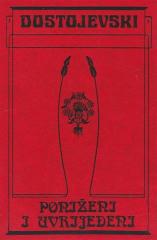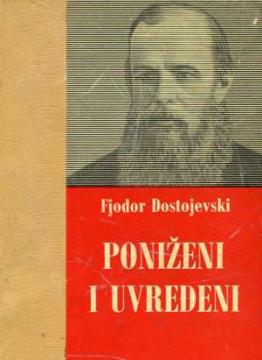

Poniženi i uvređeni

Poniženi i uvređeni

Fjodor Mihajlovič Dostojevski

The first great novel in which Dostoevsky began to explore some themes or characters that he would develop in his later works.

A story that talks about love, family and forgiveness in a realistic way. Nataša leaves her home and runs away with Alyosha, the son of Prince Valkovski. Everyone condemns her, her father scolds her, and her only comfort is her childhood friend Ivan, who is sincerely in love with her. Alyosha is a young man who is easy to manipulate, he is especially lenient when it comes to his father. Valkovski persuades him to leave Natasha, because he does not like her background. Alyosha is unable to resist his father and marries Katarina, a rich princess.

Translation
Miroslav Babović
Editor
Jovan Nedeljković
Illustrations
Sreten Grujić
Graphics design
Lj. Pavićević Fis
Dimensions
17 x 12.5 cm
Pages
349
Publisher
Nolit, Beograd, 1966.
 
Latin alphabet. Hardcover.
Language: Serbian.

No copies available

The last copy was sold recently.
 

Are you interested in another book? You can search the offer using our search engine or browse books by category.

You may also be interested in these titles

Ujakov san / Poniženi i uvrijeđeni

Ujakov san / Poniženi i uvrijeđeni

Fjodor Mihajlovič Dostojevski

Both works reflect Dostoevsky's early phase, with a focus on social criticism, psychological analysis and moral dilemmas, foreshadowing the themes of his later masterpieces.

Znanje, 1982.
Croatian. Latin alphabet. Hardcover.
13.269.28
Mladac

Mladac

Fjodor Mihajlovič Dostojevski

The Young Man (1875) by Fyodor Dostoevsky is a complex novel about coming of age, moral struggles, and social conflicts in 19th-century Russia. The novel, although less well-known, is a powerful portrayal of internal struggle and social tensions, with an

Znanje, 1982.
Croatian. Latin alphabet. Hardcover.
11.50
Selo Stepančikovo

Selo Stepančikovo

Fjodor Mihajlovič Dostojevski

"The Village of Stepanchikovo" is a humorous novel by Dostoyevsky, first published in 1859. This novel, which differs from the later, darker works of the author, is a satirical critique of social relations and human weaknesses.

Svjetlost, 1962.
Serbian. Latin alphabet. Paperback.
4.22 - 4.76
Ulazeći u Varcar

Ulazeći u Varcar

Ivan Lovrenović

The hybrid book – a novel, poem and essay in one – is a dedication to his native Varcar, a small village in central Bosnia, where the author's roots intertwine with the history, myth and chaos of the 20th century.

Fraktura, 2016.
Croatian. Latin alphabet. Hardcover with dust jacket.
14.42
Zagrepčanka

Zagrepčanka

Branislav Glumac

Branislav Glumac published a novel without periods or commas in 1974, as the relentless stream of thought of a young rebel. Published in socialist Yugoslavia, the work caused a scandal with its openness and became a classic about generational rebellion.

IROS, 1986.
Croatian. Latin alphabet. Hardcover.
8.22 - 8.24
Stotina godina (antikronika)

Stotina godina (antikronika)

Dario Harjaček

The novel One Hundred Years by Dario Harjaček provides a panoramic view of Trešnjevka and its inhabitants through a century of changes, ideologies, and human destinies – a mosaic of Zagreb in which life, art, and history intertwine.

Oceanmore, 2025.
Croatian. Latin alphabet. Paperback.
13.42