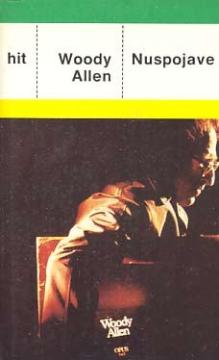
Nuspojave

Nuspojave

Woody Allen

Woody Allen's Side Effects is a collection of humorous stories and essays in which the author uses absurd situations, parody, and dark humor to poke fun at love, death, psychology, science, politics, and contemporary life.

Side Effects is a collection of seventeen humorous stories and essays by American writer, director, and comedian Woody Allen. The work does not consist of a single plot, but rather a series of independent texts in which Allen uses satire, parody, and absurdity to ridicule various phenomena of modern society.

Among the most famous stories is “Memory of the Twenties” (The Kugelmass Episode), in which literature professor Sidney Kugelmass, dissatisfied with his marriage and everyday life, with the help of a magician literally enters the novel Anna Karenina. There he begins a love affair with Anna Karenina, but the boundaries between literature and reality soon begin to dissolve, leading to a series of comic situations.

In other texts, Allen parodies detective stories, philosophical discussions, psychiatry, history, and scientific theories. Clumsy intellectuals, neurotic lovers, confused professors and eccentric scientists appear, trying to solve big life problems, but in the process creating even greater chaos. The characters often engage in endless discussions about the meaning of life, sex, art and death, while completely absurd events unfold around them.

The special feature of the collection lies in the fusion of high culture and everyday situations. Allen plays with literary classics, philosophical ideas and historical figures, but presents them through the prism of humor and irony. Behind the comic dialogues, serious questions about human loneliness, fear of death, failed love relationships and the search for happiness are often hidden.

Side Effects is considered one of Allen's best prose books because it successfully transfers his distinctive humor – intelligent, self-ironic and full of literary allusions – from the film medium to literature.

Original title
Side Effects
Translation
Omer Lakomica
Editor
Zlatko Crnković
Graphics design
Alfred Pal
Dimensions
19.5 x 12.5 cm
Pages
146
Publisher
Znanje, Zagreb, 1985.
 
Distribution: 5,000 copies
 
Latin alphabet. Hardcover with dust jacket.
Language: Croatian.

One copy is available

Condition:Used, excellent condition
 

Are you interested in another book? You can search the offer using our search engine or browse books by category.

You may also be interested in these titles

Sol, ovce i kamenje

Sol, ovce i kamenje

Magdaléna Platzová

A fresh, uninhibited literary view of Dalmatia. Four stories about Dalmatia told in the manner of the best pages of Czech literature. Bringing to life the scents of salt and sea, the author writes vivid prose full of color and flavor.

Fraktura, 2006.
Croatian. Latin alphabet. Paperback.
8.54
Mijenjanje

Mijenjanje

Liv Ullmann

Liv Ullmann in Changing illuminates a remarkable life transformation – from a little girl from Norway to a world-renowned actress. Throughout her life, she becomes increasingly confident in the most important aspects – passionate about her art, but also v

Otokar Keršovani, 1980.
Croatian. Latin alphabet. Hardcover with dust jacket.
4.26
Poezija i zbilja

Poezija i zbilja

Johann Wolfgang Goethe

Goethe's greatest autobiographical prose, written between 1811 and 1833, covers his life from his birth in 1749 in Frankfurt to 1775, when he went to Weimar at the invitation of Duke Karl August.

Matica hrvatska, 1953.
Croatian. Latin alphabet. Hardcover with dust jacket.
18.42
Bosna sjete i zaborava

Bosna sjete i zaborava

Enes Karić

Essays about the land of inexhaustible inspirations.

Durieux, 1997.
Croatian. Latin alphabet. Paperback.
5.32
Po-etika, knjiga druga

Po-etika, knjiga druga

Danilo Kiš

A collection of interviews that complements the first book of essays from 1972. As a lecturer in Serbo-Croatian at the University of Bordeaux, Kiš reveals in conversations the core of his "po-ethics" - a morally and aesthetically charged vision of literat

Ideje, 1974.
Serbian. Latin alphabet. Paperback.
8.56
Kako što nastaje: novine, film, teatar

Kako što nastaje: novine, film, teatar

Karel Čapek

In a witty and instructive essay, Čapek describes how a newspaper, a film, and a theater play are created. Through humor and irony, he shows the complexity of the process – from idea to realization – and the different perspectives of the participants, dem

Znanje, 1985.
Croatian. Latin alphabet. Paperback.
4.76