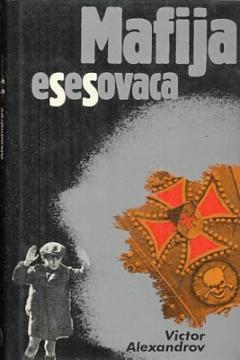
Mafija esesovaca

Mafija esesovaca

Victor Alexandrov

In this book, the author describes in detail how a precisely thought-out plan on the secret continuation of the activities of the SS, which was created during World War II, was put into practice.

After the collapse of Nazi Germany, the so-called a kingdom of shadows still ruled by former Nazis. They are still very influential in many small and medium-sized businesses in Western Europe, their representatives are members of the management boards of powerful banking consortia, they are present in various transnational economic groups, and judging by many indications, they have also placed themselves in the police intelligence structures of some countries.

Original title
La mafia des ss
Translation
Tihomira Putanec
Editor
Ana Buljan
Graphics design
Branislav Fajon
Dimensions
20.5 x 14 cm
Pages
292
Publisher
Globus, Zagreb, 1982.
 
Latin alphabet. Hardcover with dust jacket.
Language: Croatian.

No copies available

The last copy was sold recently.
 

Are you interested in another book? You can search the offer using our search engine or browse books by category.

You may also be interested in these titles

Zaraćeno poraće: Konfliktni i konkurentski narativi o stradanju i iseljavanju Talijana Istre

Zaraćeno poraće: Konfliktni i konkurentski narativi o stradanju i iseljavanju Talijana Istre

Franko Dota

The book analyzes how conflicting historical narratives about the suffering and mass emigration of Italians from Istria and Rijeka developed in Croatia and Italy after World War II (1943–1956), debunking myths and encouraging an empathetic approach to the

Srednja Europa, 2010.
Croatian. Latin alphabet. Paperback.
11.32
Slučaj Kappler : Od Ardeatina do Soltaua

Slučaj Kappler : Od Ardeatina do Soltaua

Guido Gerosa

Who was Herbert Kappler? Chief of the Gestapo in Rome during Nazi rule in the months of terror that preceded the liberation.

Otokar Keršovani, 1978.
Croatian. Latin alphabet. Paperback.
5.484.38
"Enigma" do pobjede

"Enigma" do pobjede

Ilija Marinković

The story of three Polish mathematicians who cracked the German Enigma cipher machine in the 1930s. Their secret work allowed the Allies to read Nazi messages during the war, shortening it by years and saving millions of lives.

Vjesnik, 1977.
Croatian. Latin alphabet. Hardcover.
6.325.06
YU-GENOCID: Bleiburg, Križni put, Udba

YU-GENOCID: Bleiburg, Križni put, Udba

Ante Beljo

A non-fiction book by Ante Belja about post-war liquidations, repression by the Yugoslav authorities and the activities of the UDBA, from the perspective of Croatian political emigration.

HIŠAK, 1990.
Croatian. Latin alphabet. Paperback.
12.34
Hrvatska borba za opstojnost 1918.-1998.

Hrvatska borba za opstojnost 1918.-1998.

Milivoj Kujundžić, Zdravko Dizdar

The book contains an account of the history of Croatia from 1918 to 1998 in four historical periods (1918-1941; 1941-1945, 1945-1990 and 1990-1998).

Hrvatski državni sabor, 2000.
Croatian. Latin alphabet. Hardcover.
6.42
Ko je bio Alojzije Stepinac

Ko je bio Alojzije Stepinac

Ivan Cvitković

A sociological-historical study in which Ivan Cvitković analyzes the activities of the Archbishop of Zagreb in the context of the Independent State of Croatia, World War II and the post-war period, relying on sources available at the time.

NIŠRO Oslobođenje, 1986.
Croatian. Latin alphabet. Hardcover with dust jacket.
11.62