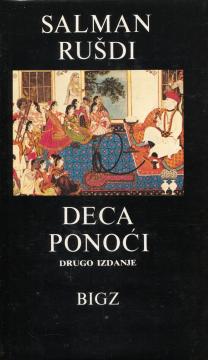
Deca ponoći

Deca ponoći

Salman Rushdie
Original title
Midnight's children
Translation
Svetozar Koljević, Zoran Mutić
Dimensions
21 x 12.5 cm
Pages
623
Publisher
BIGZ, Beograd, 1987.
 
Latin alphabet. Hardcover with dust jacket.
Language: Croatian.
ISBN
8-61-300110-6

No copies available

The last copy was sold recently.
 

Are you interested in another book? You can search the offer using our search engine or browse books by category.

You may also be interested in these titles

Mavrov poslednji uzdah

Mavrov poslednji uzdah

Salman Rushdie

The knight of the British crown and one of the best modern world writers once again shows all the splendor of his incredible talent.

Narodna knjiga, 1997.
Serbian. Cyrillic alphabet. Paperback.
4.62
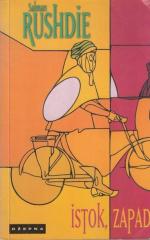
Istok, zapad

Istok, zapad

Salman Rushdie

"East, West" is a collection of short stories by Salman Rushdie that explores themes of identity, culture, and the overlap between East and West.

Vuković & Runjić, 1999.
Croatian. Latin alphabet. Paperback.
4.78
Aurorin poticaj

Aurorin poticaj

Erich Hackl

The work is based on a true event that occurred in Spain in 1933: Aurora Rodriguez killed her daughter Hildegart, a famous fighter for women's emancipation and a cult figure on the political scene of the time.

Mladost, 1990.
Croatian. Latin alphabet. Hardcover with dust jacket.
4.96 - 4.98
Deobe

Deobe

Dobrica Ćosić

Deobe is a novel about the tragic division of Serbs into Chetniks and Partisans during World War II. Winner of the NIN Award, it is part of a wider epic trilogy, inspired by Ćosić's experiences and historical documents.

Prosveta, 1963.
Croatian. Latin alphabet. Hardcover with dust jacket.
13.74
Dok ležah na samrti

Dok ležah na samrti

William Faulkner

Faulkner's 1930 novel, a classic example of modernist literature. It is often compared to Joyce's "Ulysses" for its innovative structure, but is more accessible due to its focus on family.

Rad, 1985.
Croatian. Latin alphabet. Paperback.
3.26
Deobe 1-3

Deobe 1-3

Dobrica Ćosić

This work, awarded the NIN Prize for that year, is considered one of the most significant in Serbian literature after World War II.

Prosveta, 1961.
Serbian. Cyrillic alphabet. Hardcover with dust jacket.
The book consists of 3 volumes
11.42