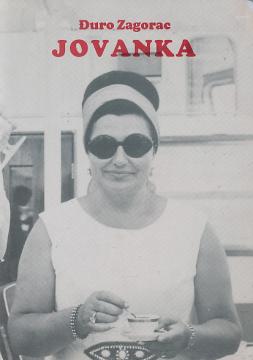
Jovanka

Jovanka

Đuro Zagorac

The drama of the Broz family was kept in the utmost secrecy. Until once, naturally.

The most ideal for Jovanka's "tranquility" was the residence of the Broz family in Belgrade, or one of the villas on the Brionsko islands. Jovanka often emerged from them, waiting... for her man. And he wasn't there. In her anger, she knew how to recall the fate of her mother Milica, who was anxiously wondering if her man, who had gone to America, would appear from somewhere.

Editor
Dušan Mrđenović, Veljko Topalović
Dimensions
20 x 14 cm
Pages
252
Publisher
Dosije, Beograd, 1990.
 
Distribution: 5,000 copies
 
Latin alphabet. Paperback.
Language: Serbian.
ISBN
8-68-156307-6

No copies available

The last copy was sold recently.
 

Are you interested in another book? You can search the offer using our search engine or browse books by category.

You may also be interested in these titles

Jevreji u Jugoslaviji 1944–1952: Kraj ili novi početak

Jevreji u Jugoslaviji 1944–1952: Kraj ili novi početak

Mladenka Ivanković

Jews in Yugoslavia 1944–1952 by Mladenka Ivanković depicts the renewal of the life of the Jewish community after the Holocaust, its relationship with the new authorities, and emigration to Israel and the preservation of identity.

Institut za noviju istoriju Srbije, 2009.
Serbian. Latin alphabet. Hardcover.
36.42
Knjiga o Srebrenici – spomenar jednog grada

Knjiga o Srebrenici – spomenar jednog grada

Sadik Salimović

Sadik Salimović's Book of Srebrenica (2002) is a memoir of the city: from Ottoman settlement, Islamization and development to the war suffering of 1992–1995 and genocide. It preserves the identity and memory of life before and after the tragedy.

Skupština opštine Srebrenica, 2002.
Croatian. Latin alphabet. Paperback.
11.32
Zaraćeno poraće: Konfliktni i konkurentski narativi o stradanju i iseljavanju Talijana Istre

Zaraćeno poraće: Konfliktni i konkurentski narativi o stradanju i iseljavanju Talijana Istre

Franko Dota

The book analyzes how conflicting historical narratives about the suffering and mass emigration of Italians from Istria and Rijeka developed in Croatia and Italy after World War II (1943–1956), debunking myths and encouraging an empathetic approach to the

Srednja Europa, 2010.
Croatian. Latin alphabet. Paperback.
11.327.92
Oluja koju nismo mogli izbjeći

Oluja koju nismo mogli izbjeći

Ante Gugo

Ante Gugo explains the breakup of Yugoslavia, the formation of the Croatian state, and the circumstances that led to Operation Storm through a chronological account of events from 1985 to 1995.

Večernji list, 2015.
Croatian. Latin alphabet. Paperback.
18.42
Doživljaji i putovanja do slobode

Doživljaji i putovanja do slobode

Vladimir Novak

The autobiographical work of Croatian communist activist Vladimir Novak, a survivor of the Ustasha camps, follows his memories of resistance to fascism during World War II.

August Cesarec, 1979.
Croatian. Latin alphabet. Hardcover with dust jacket.
8.26
Umiruće tijelo politike: Rat - konstitucija nacionalnog tijela

Umiruće tijelo politike: Rat - konstitucija nacionalnog tijela

Senadin Musabegović

The philosophical and theoretical study by a Bosnian-Herzegovinian author analyzes how the war in Bosnia and Herzegovina from 1992 to 1995 was a biopolitical project of creating a "pure" national body through the systematic killing, expulsion, and rape of

Buybook, 2019.
Croatian. Latin alphabet. Paperback.
11.247.87