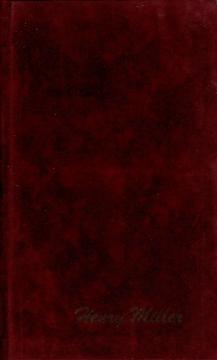
Ružičasto raspeće I: Sexus

Ružičasto raspeće I: Sexus

Henry Miller

Henry Miller's "Sexus" is part of the "Pink Crucifixion" trilogy, in which, with less intensity than in his most famous works published in the 1930s in Paris, his rebellion against the arrogant and hypocritical America is sublimated.

Miller's novels were banned in America for nearly thirty years, which ensured his "underground" reputation until the US Supreme Court in 1964 rejected the State Court's obscenity charges. It was these works in American literature that began the opening towards sexual themes, freeing them from legal and social restrictions.

Henry Miller (New York 1891 - Pacific Palisades, California 1980) published several essays and short stories in American magazines by the age of thirty. After a series of different jobs in New York, in 1930 he went to Paris, where he lived in poverty for a year. Then he gets a job as a proofreader in the Paris edition of the daily "The Chicago Tribune", thanks to his friend Alfred Perles, under whose name he also publishes several articles. He started writing seriously at the age of almost forty. His novels, especially Rakov obratnica (1934), caused a lot of controversy in America, and were even banned, so the novels "Black spring" (1936) and "Capricorn obratnica" (1936) were banned for almost thirty years.

In 1940, Miller returned to the USA and settled in California, where he continued to write and provoke contemporary American society, its cultural and moral values. Miller was also involved in painting - his watercolors are stored in two museums - "The Henry Miller Museum of Art" in the Japanese city of Omachi, and "The Henry Miller Art Museum" in Big Sur, California. Henry Miller's work, almost entirely autobiographical in nature, greatly influenced the writers of the beat generation.

Original title
The Rosy Crucifixtion I: Sexus
Translation
Zlatko Crnković
Dimensions
20 x 12 cm
Pages
519
Publisher
Otokar Keršovani, Rijeka, 1978.
 
Latin alphabet. Hardcover.
Language: Croatian.

No copies available

The last copy was sold recently.
 

Are you interested in another book? You can search the offer using our search engine or browse books by category.

You may also be interested in these titles

Cvet Henrija Milera

Cvet Henrija Milera

Henry Miller

The book Flower by Henry Miller is based on a selection from the best and most attractive works of this writer, following the chronological sequence in Miller's writing, giving Miller's most artistically mature pages.

BIGZ, 1988.
Serbian. Latin alphabet. Paperback.
5.32
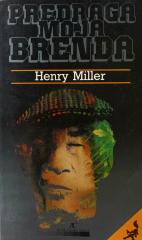
Predraga moja Brenda

Predraga moja Brenda

Henry Miller

Henry Miller's Love Letters to Brenda Venus. If you're looking for Miller's raw passion in a tender epilogue, this is an emotional glimpse into the heart of a rebel—touching, witty, and compelling.

August Cesarec, 1987.
Croatian. Latin alphabet. Paperback.
4.32
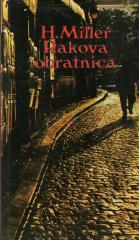
Rakova obratnica

Rakova obratnica

Henry Miller

This is an accusation, a slander, a personal insult. This is not a book, in the ordinary sense of the word. No, this is a continuous insult, a spit in the face of Art, a foot in the tur against God, Man, Fate, Time, Love, Beauty...whatever you want.

Sveučilišna naklada Liber (SNL), 1981.
Croatian. Latin alphabet. Hardcover with dust jacket.
6.30 - 7.56
Deobe

Deobe

Dobrica Ćosić

Deobe is a novel about the tragic division of Serbs into Chetniks and Partisans during World War II. Winner of the NIN Award, it is part of a wider epic trilogy, inspired by Ćosić's experiences and historical documents.

Prosveta, 1963.
Croatian. Latin alphabet. Hardcover with dust jacket.
13.74
Pariški maraton : Knjiga pisanja (Pariz21. i 22. oktobar 2023)

Pariški maraton : Knjiga pisanja (Pariz21. i 22. oktobar 2023)

At the end of the eighties, Damir Uzunović traveled to Paris and stayed there for less than a year. He was twenty years old at the time, and that exile episode would be formative for the literature he would later write.

Buybook, 2024.
Croatian. Latin alphabet. Hardcover.
12.22
Proces

Proces

Franz Kafka

Kafka wrote The Process between 1914 and 1915, published posthumously in 1925. The novel is unfinished but with an added final chapter by Max Brod. Edition with a foreword by B. Živojinović and an afterword by Walter Killi.

BIGZ, 1990.
Serbian. Latin alphabet. Paperback.
4.26