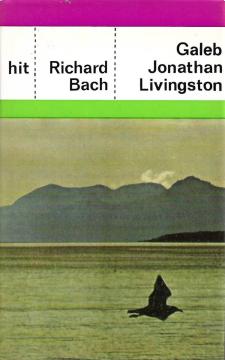
Galeb Jonathan Livingston

Galeb Jonathan Livingston

Richard Bach

The allegorical story of Jonathan the seagull has been one of the best-selling classics of spiritual-philosophical literature for decades, and millions of people consider it to have changed their lives. With Galeb Jontahan Livingston, we will fly to (un)k

The novel is written in short and clear sentences understandable by most ages. Along with the abundant interweaving of various storytelling techniques, we meet monologue, dialogue, description used to evoke various types of flying, and storytelling that evokes the life and behavior of seagulls. Elements of today's life can be found in many sentences.

Seagull Jonathan Livingston stands out from the flock because of his great desire to learn to fly as well as possible. Although he tried to fit in with the other seagulls, due to new flight experiments the flock ostracized him and he practiced in solitude. He soon encounters like-minded people and reaches incredible flying speeds that enable him to "jump" through space and time. He is also taught by the brave seagull Zhang. Jonathan had the need to return to his flock on Earth and in the end he himself becomes a teacher to the seagulls who, like him once, dared to fly freely and were ostracized. There were more and more of them. In the end, Johnatan moves on because he has done his job - he taught the other seagulls that there are no limits in the race for knowledge.

Original title
Jonathan Livingston Seagull
Translation
Diana Pavičić-Haniš
Editor
Zlatko Crnković
Illustrations
Russell Munson
Graphics design
Alfred Pal
Dimensions
20 x 12 cm
Pages
93
Publisher
Znanje, Zagreb, 1979.
 
Latin alphabet. Hardcover with dust jacket.
Language: Croatian.

No copies available

The last copy was sold recently.
 

Are you interested in another book? You can search the offer using our search engine or browse books by category.

You may also be interested in these titles

Tarzan gospodar zvjeradi

Tarzan gospodar zvjeradi

Edgar Rice Burroughs

The third novel in the famous Tarzan series. Tarzan's enemies kidnap his son and Jane, leaving him trapped on a deserted island. With the help of beasts (apes, panthers, and lions), Tarzan takes revenge and saves his family.

St. Kugli, 1933.
Croatian. Latin alphabet. Hardcover.
9.44
Dinamit: Povijest klasnog nasilja u Americi

Dinamit: Povijest klasnog nasilja u Americi

Louis Adamić

The book documents a century of violence in the American labor movement — from 19th-century mining strikes to bombings and clashes with police — and exposes the brutal background to America's "class war."

Naklada Binoza, 1933.
Croatian. Latin alphabet. Hardcover with dust jacket.
7.24
Nomadi sjevera

Nomadi sjevera

James Oliver Curwood

"Nomads of the North" is an adventure work about the life of animals in the wilderness of northern Canada. Through the friendship of a dog and a bear cub, it depicts the struggle for survival, the power of nature, and life in harsh regions.

Naklada slavenske knjižare St. i M. Radić, 1925.
Croatian. Latin alphabet. Paperback.
7.32
Zlatni lanac

Zlatni lanac

Upton Sinclair

Upton Sinclair sharply criticizes the relationship between art and capital throughout history. He shows how money and power have always influenced literature, painting, and music, and how great artists were often prisoners of the "golden chain."

Biblioteka savremenih pisaca, 1932.
Croatian. Latin alphabet. Hardcover with dust jacket.
6.24
Preko reke i u šumu

Preko reke i u šumu

Ernest Hemingway

Over the River and Into the Woods (1950) is a novel by the American writer Ernest Hemingway. The title is derived from the last words of American Civil War Confederate General Thomas J. "Stonewall" Jackson.

Minerva, 1956.
Serbian. Latin alphabet. Hardcover.
5.00
Špijunska baza Tokio

Špijunska baza Tokio

Martin Cruz-Smith

Days before the attack on Pearl Harbor, Harry Niles attempts to escape Tokyo. In a whirlwind of espionage, deceit, and threats of war, he must decide who he can trust.

Algoritam, 2005.
Croatian. Latin alphabet. Paperback.
3.86