Istočna Slavonija: Stanovništvo i naselja

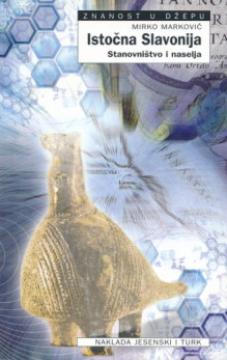
Istočna Slavonija: Stanovništvo i naselja

Mirko Marković

In the book, academician Mirko Marković briefly analyzes the origin of settlements and the development of the population in Eastern Slavonia, based on the data he collected during his rich and decades-long research of this area.

The history of Eastern Slavonia, i.e. the area east of Osijek, Đakovo and Županja, goes back to the Neolithic period, when the first settlements were established in the area of ​​Vinkovci, Osijek, Vukovar and Vučedol. In the book, we briefly get to know the characteristics of the earliest cultures, including the Vučedol culture, from which the most recognizable archaeological find from that area originates - a ceramic vessel in the shape of a dove. Then the periods of Roman rule in Pannonia, the immigration of Croats to Pannonia and the establishment of Pannonian Croatia and the Kingdom of Croatia, Turkish rule and the settlement of the Šokacs and Bunjevics were covered. The recent history of the Iloc, Vukovar, Dal, Osijek, Vinkovac, Đakovo and Župan areas is specially covered. Concise and concise in its approach, the book also abounds with many interesting facts - about the beginnings of grapevine cultivation, legends, autochthonous families, the origin of the names of villages and towns and urban areas... Prof. Mirko Marković, Ph.D., worked at the Institute of Ethnology at HAZU for forty years and managed it for twenty years. He has been a member of HAZU since 1980. He published around two hundred professional and scientific works, including a dozen more voluminous books. He mostly studied the past of Croatian settlements, old maps and plans, and population migrations. The same library also published his studies Ličani through the past, Croatia on old maps, Hrvatsko zagorje. Population and settlements.

Editor
Mišo Nejašmić
Dimensions
18 x 11 cm
Pages
127
Publisher
Jesenski i Turk, Zagreb, 2003.
 
Latin alphabet. Paperback.
Language: Croatian.
ISBN
978-9-53222-123-7

No copies available

The last copy was sold recently.
 

Are you interested in another book? You can search the offer using our search engine or browse books by category.

You may also be interested in these titles

Balada o Nikoli Gorjanskom

Balada o Nikoli Gorjanskom

Vlado Nemet
Tilia, 1994.
Croatian. Latin alphabet. Hardcover.
2.98
Komunizam i čovjek: Odnos vlasti i pojedinca u Hrvatskoj (1958.–1972.)

Komunizam i čovjek: Odnos vlasti i pojedinca u Hrvatskoj (1958.–1972.)

Josip Mihaljević

Josip Mihaljević's book analyzes the relationship between the government and the individual in communist Croatia (1958–1972), through repressive mechanisms, ideological pressures, and restrictions on personal freedom in the socialist system.

Hrvatski institut za povijest, 2016.
Croatian. Latin alphabet. Hardcover.
17.26
Radni logor Valpovo 1945.-1946.: dokumenti

Radni logor Valpovo 1945.-1946.: dokumenti

Vladimir Geiger

The Valpovo labor camp (1945–1946) was the largest camp for Volksdeutschers in Croatia after World War II. About 4,000 Germans and Austrians were interned; at least 1,074 died, mostly from hunger, disease, and exhausting labor.

Njemačka zajednica podunavskih Švaba u Hrvatskoj, 1999.
Croatian. Latin alphabet. Hardcover.
27.34
Od Pola do Malnara: Putnici i istraživači u hrvatskoj kulturi od 13. do 20. stoljeća

Od Pola do Malnara: Putnici i istraživači u hrvatskoj kulturi od 13. do 20. stoljeća

Juraj Bubalo

The book by Zagreb travel writer and professor Juraj Bubalo is a kind of encyclopedia of Croatian travelers and explorers. Unique in Croatian non-fiction, it popularizes the culture of exploration and reminds us that Croats have been part of global discov

Meridijani, 2024.
Croatian. Latin alphabet. Hardcover.
28.32
Osječka groblja

Osječka groblja

Stjepan Sršan

The book is deeply rooted in the local history and culture of Osijek, with an emphasis on cemetery motifs that serve as a metaphor for memory, death, and disappearance.

Povijesni arhiv u Osijeku, 1996.
Croatian. Latin alphabet. Paperback.
5.263.95
Tragom prošlosti Broda

Tragom prošlosti Broda

Vladimir Rem

A local feuilleton chronicle of Slavonski Brod from Roman times (Marsunija), through Turkish rule, the Military Border and the fortress to the 19th/20th century. A warm, nostalgic account of the history, customs and sights of the town.

Vlastita naklada, 1965.
Croatian. Latin alphabet. Paperback.
6.72