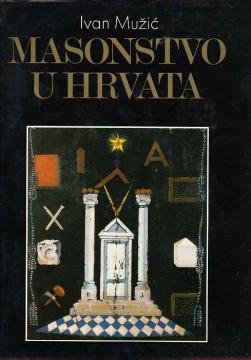
This book highlights the leading ideas of Croatian freemasons and their active role in politics.
All modern Croatian history, also in relation to Yugoslavian and world events, is presented on the pages of this book in terms of the contribution, sometimes decisive, of Freemasonry. Mužić's work, unique in its kind, is an extremely important contribution to better understanding of Freemasonry.
A detailed biography of Stjepan Radić in the period from 1918 until his death in 1928. The author uses archival and other documentation to provide a new evaluation of the Croatian historical and political reality between the two world wars.
Nakladni zavod Matice hrvatske, 1990.
Croatian. Latin alphabet. Hardcover with dust jacket.
The book is deeply rooted in the local history and culture of Osijek, with an emphasis on cemetery motifs that serve as a metaphor for memory, death, and disappearance.
A pioneering attempt at a systematic presentation of Croatian political history from the settlement of Croats to the conclusion of a personal union with Hungary. Segher chronologically traces the development of Croatian statehood, relying on the sources a
Josip Mihaljević's book analyzes the relationship between the government and the individual in communist Croatia (1958–1972), through repressive mechanisms, ideological pressures, and restrictions on personal freedom in the socialist system.
Hrvatski institut za povijest, 2016.
Croatian. Latin alphabet. Hardcover.
17.26 €
Law • Documents and records • Croatian history • Interviews • Collections and chronologies
The book In Defense of the Disenfranchised Bishops by Franjo Komarica is a collection of around 300 documents, letters, appeals and statements published by the Bishop of Banja Luka and the Episcopal Ordinariate of Banja Luka during the war years from 1991