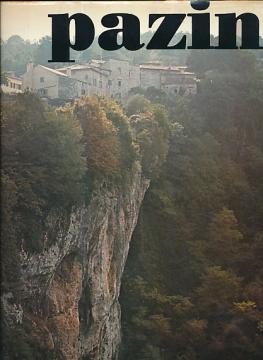
Pazin

Pazin

Petar Strčić

Pazin is a town in central Istria, known for its rich history and natural beauty. It is located above the karst abyss of Pazinska jama, into which the river Pazinčica plunges.

The city is the center of the economic, cultural, educational, sports and entertainment life of central Istria. Pazin covers an area of ​​136.54 km² and consists of 18 settlements, including Beram, Bertoši, Brajkovići, Butoniga, Grdoselo, Heki, Ježenj, Kašćerga, Kršikla, Lindar, Lovrin, Trviž, Vela Traba, Zabrežani, Zamask, Zamaski Dol and Zarečje.

Editor
Nebojša Tomašević
Illustrations
Budim Budimovski, Luccio Debeljuh, Virgilio Giuricin, Dimitrije Mnolev
Graphics design
Miodrag Vartabedijan
Dimensions
30 x 24.5 cm
Pages
183
Publisher
Skupština općine Pazin, Pazin, 1982.
 
Latin alphabet. Hardcover with dust jacket.
Language: Croatian.

One copy is available

Condition:Used, excellent condition
 

Are you interested in another book? You can search the offer using our search engine or browse books by category.

You may also be interested in these titles

Locirati, identificirati, uhititi, transferirati: Izdajnici i sluge

Locirati, identificirati, uhititi, transferirati: Izdajnici i sluge

Journalist Milan Ivkošić said that the book contains texts by authors who differ ideologically and that some of them do not share Glavaš's views, but, as he maintains, wrote objectively about his case.

HVIDR-a, 2007.
Croatian. Latin alphabet. Hardcover.
6.98
Stjepan Radić

Stjepan Radić

The Stjepan Radić exhibition catalogue, published in 1991 on the occasion of the exhibition at the Croatian History Museum in Zagreb, is dedicated to the life and work of Stjepan Radić (1871–1928), a key figure in Croatian politics and the founder of the

Hrvatski povijesni muzej, 1991.
Croatian. Latin alphabet. Paperback.
6.42
Radni logor Valpovo 1945.-1946.: dokumenti

Radni logor Valpovo 1945.-1946.: dokumenti

Vladimir Geiger

The Valpovo labor camp (1945–1946) was the largest camp for Volksdeutschers in Croatia after World War II. About 4,000 Germans and Austrians were interned; at least 1,074 died, mostly from hunger, disease, and exhausting labor.

Njemačka zajednica podunavskih Švaba u Hrvatskoj, 1999.
Croatian. Latin alphabet. Hardcover.
27.34
Juraj Križanić: Sabrana građa o 300-obljetnici smrti (1683-1983)

Juraj Križanić: Sabrana građa o 300-obljetnici smrti (1683-1983)

Ivan Golub

Collected materials on the 300th anniversary of his death (1683-1983)

Kršćanska sadašnjost, 1983.
Croatian. Latin alphabet. Paperback.
9.166.41
Najveći hrvatski znanstvenici

Najveći hrvatski znanstvenici

Hrvoje Kekez

This book presents forty of the most distinguished Croatian scientists from the late Middle Ages to the present day, i.e. from Benedikt Kotruljević to Ivan Supek.

Mozaik knjiga, 2011.
Croatian. Latin alphabet. Paperback.
6.325.06
Proizvodnja pokljuka u Požeškom Novom Selu: Separat

Proizvodnja pokljuka u Požeškom Novom Selu: Separat

Zdenka Lechner

Zdenka Lechner, the first ethnologist at the Museum of Slavonia (1951–1965), made significant contributions to the study of the traditional culture of Slavonia, including the use of pokljuc – earthen lids for baking bread and pastries on the hearth.

Muzej Slavonije, 1962.
Croatian. Latin alphabet. Paperback.
6.32