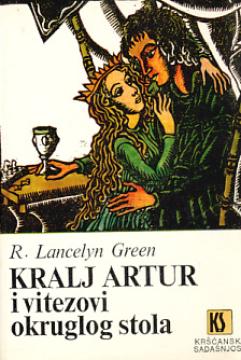
Kralj Artur i vitezovi okruglog stola

Kralj Artur i vitezovi okruglog stola

Roger Lancelyn Green

With an abundance of beautiful illustrations, the book consists of five thematic units: Arthur's arrival; Knights of the Round Table; In Search of the Holy Grail; Arthur's departure and Epilogue.

"The story of King Arthur and the adventures of his knights has been told so many times that, at first glance, there is really no reason to retell it. But, if we exclude the poetic versions based on the legends, the versions of the poets Dryden, Morris, Tennyson, Swinburne and Charles Williams, the majority of English writers simply summarized the narration of Sir Thomas Malory, and although, already accepting the age of their readership, they omitted or simplified some parts , has almost never deviated significantly from Malory's text. It has recently been discovered that Malory did not conceive his book about King Arthur as a whole, but only as a collection of unrelated stories, told on the basis of old French romances. There is, admittedly, a certain connection, but there is no firm plan. Therefore, I have tried here to fit each adventure into a stronger whole of Arthur's kingdom and the empire of Logres, that model of chivalry and good in the fight against barbarism and evil, which, in the end, finally won. So, these are the foundations on which I built. I have tried to build a structure from the most famous adventures and exploits and from the most persistent pursuits of the famous knights of the Round Table. I also created some lesser-known short stories that fit into the whole."

Translation
Nada Horvat
Dimensions
17 x 12 cm
Pages
356
Publisher
Kršćanska sadašnjost, Zagreb, 1983.
 
Latin alphabet. Paperback.
Language: Croatian.

No copies available

The last copy was sold recently.


Are you interested in another book? You can search the offer using our search engine or browse books by category.

You may also be interested in these titles

Stid

Stid

Tito Bilopavlović
Znanje, 1980.
Croatian. Latin alphabet. Paperback.
2.99
Exodus

Exodus

Leon Uris

Exodus (1958), an epic saga about the founding of Israel, inspired by true historical events, follows a group of Jewish refugees in post-World War II Europe as they fight to establish a homeland in Palestine.

August Cesarec, 1982.
Croatian. Latin alphabet. Hardcover with dust jacket.
The book consists of two volumes
11.26 - 11.36
Najmlađi Jagodić neće u roman

Najmlađi Jagodić neće u roman

Dušan Matić
Narodna knjiga, 1988.
Serbian. Latin alphabet. Paperback with dust jacket.
7.99
Kako sam preživjela

Kako sam preživjela

Doris Lessing

The novel How I Survived (1974) by Doris Lessing is a dystopian novel that follows the unnamed narrator, a middle-aged woman, in a futuristic city collapsing due to social and economic collapse.

Globus, 1985.
Croatian. Latin alphabet. Hardcover with dust jacket.
5.784.34 - 6.50
Most na reci Kvaj

Most na reci Kvaj

Pierre Boulle
Minerva, 1959.
Serbian. Latin alphabet. Hardcover.
3.50
Jučer je bilo danas

Jučer je bilo danas

Ingeborg Drewitz

The novel Yesterday Was Today by German writer Ingeborg Drewitz follows the life of Gabriela, born in 1923, from childhood to old age, intertwining her personal story with the historical and social changes of the 20th century in Germany.

Globus, 1985.
Croatian. Latin alphabet. Hardcover with dust jacket.
3.98 - 4.56