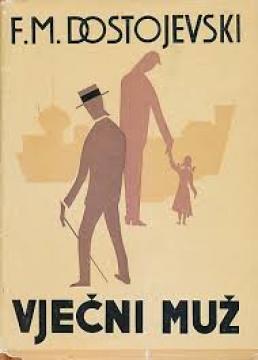
Vječni muž / Ujakov san

Vječni muž / Ujakov san

Fjodor Mihajlovič Dostojevski

„Der ewige Ehemann“ ist ein Roman von Fjodor M. Dostojewski, der erstmals 1869 veröffentlicht wurde. Eines seiner kleineren, aber bedeutenden Werke, in dem Dostojewski komplexe menschliche Emotionen wie Eifersucht, Zweifel, Angst und Leidenschaft erforsch

Der Roman konzentriert sich auf die Charaktere von Viktor Pawlowitsch, dem Doppelprotagonisten, und seinem „ewigen“ Rivalen Dmitri Karamasow (nicht zu verwechseln mit dem berühmten Dostojewski Karamasow), und die Geschichte dreht sich um ihre gegenseitigen Beziehungen, ihre Liebe zu derselben Frau, und die psychologische Tiefe ihrer Charaktere.

Viktor Pavlović ist ein leicht tollpatschiger, eifersüchtiger Ehemann und Ex-Liebhaber mittleren Alters, der zutiefst verletzt und von Eifersucht auf seine Frau Jelena besessen ist, die ihn in Pavlovićs Augen betrogen und für Dmitri verlassen hat. Er versucht, mit seinem Unglück fertig zu werden, doch seine Besessenheit führt zu tiefen inneren Konflikten, die seinen Seelenfrieden nach und nach zerstören.

In dem Roman untersucht Dostojewski die Themen Liebe, Angst, patriarchalische Trauer und Zweifel und wirft komplexe moralische Dilemmata auf. Viktor Pawlowitsch wird als „ewiger Ehemann“ dargestellt, weil er die Vergangenheit scheinbar nicht überwinden kann, während sein Rivale Dmitri ein lebhafter und impulsiver Charakter ist, der nicht an die Vergangenheit denkt.

Nachdem die Pavlovićs beschlossen haben, sich zu verabschieden und ihre Beziehung zu ihr zu erneuern, gibt Pavlović den Kampf auf.

Original title
Вечный муж
Translation
Iso Velikanović
Editor
Vladimir Gerić
Graphics design
Zoltan Gabor
Dimensions
17 x 13 cm
Pages
334
Publisher
Naprijed, Zagreb, 1958.
 
Latin alphabet. Hardcover with dust jacket.
Language: Croatian.

No copies available

The last copy was sold recently.
 

Are you interested in another book? You can search the offer using our search engine or browse books by category.

You may also be interested in these titles

Ujakov san / Poniženi i uvrijeđeni

Ujakov san / Poniženi i uvrijeđeni

Fjodor Mihajlovič Dostojevski

Both works reflect Dostoevsky's early phase, with a focus on social criticism, psychological analysis and moral dilemmas, foreshadowing the themes of his later masterpieces.

Znanje, 1982.
Croatian. Latin alphabet. Hardcover.
13.2610.61
Zapisi iz mrtvog doma / Zimske bilješke o ljetnim dojmovima / Zapisi iz podzemlja

Zapisi iz mrtvog doma / Zimske bilješke o ljetnim dojmovima / Zapisi iz podzemlja

Fjodor Mihajlovič Dostojevski

Notes from a Dead Home (1860-1862) - a novel based on the author's imprisonment in Siberia. Winter Notes on Summer Impressions (1863) - an essay from a trip to Europe in 1862. Notes from the Underworld (1864) is a philosophical novel about a man torn by i

Znanje, 1982.
Croatian. Latin alphabet. Hardcover.
16.56
Mladac

Mladac

Fjodor Mihajlovič Dostojevski

The Young Man (1875) by Fyodor Dostoevsky is a complex novel about coming of age, moral struggles, and social conflicts in 19th-century Russia. The novel, although less well-known, is a powerful portrayal of internal struggle and social tensions, with an

Znanje, 1982.
Croatian. Latin alphabet. Hardcover.
11.50
Hrvatska gibanica

Hrvatska gibanica

Josip Pavičić
Znanje, 1986.
Croatian. Latin alphabet. Paperback.
5.99
Kuću treba srušiti

Kuću treba srušiti

Tena Lončarević

The house needs to be demolished, but not before we read twenty-two stories by Tena Lončarević, which will detect and preserve in words in each room of the house the objects, shadows, sounds, emotions, and memories that need to be saved from silence befor

Fragment, 2024.
Croatian. Latin alphabet. Paperback.
9.82
Operacija Dupin

Operacija Dupin

Heinz G. Konsalik

A convoy of trucks carrying 70 trained dolphins is on its way to a US military naval base. But the strange events surrounding the dolphins become suspicious to the Soviet counter-intelligence service...

Mladinska knjiga, 1991.
Croatian. Latin alphabet. Hardcover with dust jacket.
2.78