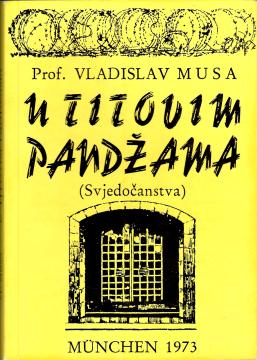
U Titovim pandžama (Svjedočanstva)
The content of the book is real and experienced in the enslaved homeland, in the dictatorship and Tito's prisons.
One copy is available

The content of the book is real and experienced in the enslaved homeland, in the dictatorship and Tito's prisons.
One copy is available
Are you interested in another book? You can search the offer using our search engine or browse books by category.
In this book of essays, Muharem Bazdulj analyzes how the collapse of Yugoslavia and the wars of the 1990s resonated in Anglo-Saxon literature – from pre-war stereotypes to war and post-war depictions.
Sadik Salimović's Book of Srebrenica (2002) is a memoir of the city: from Ottoman settlement, Islamization and development to the war suffering of 1992–1995 and genocide. It preserves the identity and memory of life before and after the tragedy.
The author explores why Tito remains a popular symbol of stability, social security and independence, despite critical views of his regime. The book maps the cultural, political and everyday manifestations of "Titostalgia".
Amir Duranović's book reconstructs in detail the dramatic year 1966 and the Fourth (Brion) Session of the Central Committee of the Communist Party of Yugoslavia (July 1–2, 1966), at which Aleksandar Ranković, the long-time head of the UDB and vice preside
The autobiographical work of Croatian communist activist Vladimir Novak, a survivor of the Ustasha camps, follows his memories of resistance to fascism during World War II.
In the book, historian William Klinger investigates the origin and operation of OZNA - the brutal repressive apparatus of communist Yugoslavia, which monitored, imprisoned and liquidated political opponents.