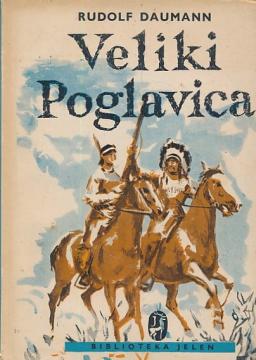
Veliki poglavica Tatanka-Yotanka: Roman o Sjedećem Biku, poglavici Siouxa

Veliki poglavica Tatanka-Yotanka: Roman o Sjedećem Biku, poglavici Siouxa

Rudolf Daumann

The novel Great Chief Tatanka-Yotanka by Rudolf Daumann tells the biographical story of the legendary Sioux chief, Sitting Bull (Tatanka Yotanka). The novel portrays Sitting Bull as a symbol of courage, resistance and dignity of indigenous peoples.

Through a historically based narrative, the novel follows his struggle to preserve the homeland, traditions and freedom of his people in the conflict with the American colonizers in the 19th century.

Sitting Bull, a charismatic leader and spiritual leader of the Lakota Sioux, led the resistance against the expansion of the American army and settlers into the Indian territories. His greatest victory occurred in 1876 at the Battle of the Little Bighorn, where the Sioux and their allies defeated General Custer and his army. But despite this triumph, the pressure from the white settlers and the army was increasing.

The novel also brings the personal side of the story - Sitting Bull was not only a warrior, but also a leader dedicated to his community. After years of resistance, he was forced to surrender to the American authorities and for a time stayed in a reservation. In the end, he was killed in 1890, on the eve of the bloody massacre at Wounded Knee, ending one of the most famous chapters in American Indian history.

Original title
Tatanka Yotanka
Translation
Oto Šolc
Editor
Grigor Vitez, Oto Šolc
Graphics design
Dalibor Parać
Dimensions
20 x 14 cm
Pages
330
Publisher
Mladost, Zagreb, 1958.
 
Latin alphabet. Paperback with dust jacket.
Language: Croatian.

No copies available

The last copy was sold recently.
 

Are you interested in another book? You can search the offer using our search engine or browse books by category.

You may also be interested in these titles

Eine Zierde in ihrem Hause: Die Geschichte der Ottilie von Faber-Castell

Eine Zierde in ihrem Hause: Die Geschichte der Ottilie von Faber-Castell

Asta Scheib

Sixteen-year-old Ottilie von Faber inherits the A. W. Faber pencil factory in 1893. Obedient to her grandfather's will, she marries without love, and after five births and twenty years, she leaves the marriage for a secret love - at a high price.

Rowohlt Verlag, 2003.
German. Latin alphabet. Paperback.
7.42
Misli

Misli

Hermann Hesse

Thoughts is a collection of selected writings, aphorisms, and reflections by Hermann Hesse about man, life, art, love, nature, freedom, and spiritual development.

Zagrebačka naklada, 2003.
Croatian. Latin alphabet. Hardcover.
11.42
U žrvnju

U žrvnju

Hermann Hesse

Hermann Hesse's novel "At the Mill" depicts the conflict between artistic ideals and social expectations through the story of a young poet trying to make it in a world limited by conventions.

Zagrebačka naklada, 2011.
Croatian. Latin alphabet. Paperback.
8.32
Das Tor zum Glück – Inspirationen zur Lebenskunst

Das Tor zum Glück – Inspirationen zur Lebenskunst

Hans Kruppa

One of the most beautiful and wisest books on the art of living. No empty phrases and false motivation – just honest wisdom seasoned with subtle humor and warmth.

Droemer Knaur, 2006.
Croatian. Latin alphabet. Hardcover with dust jacket.
3.42
Die Räuber

Die Räuber

Friedrich Schiller

"Die Räuber" (1781) is Schiller's first play, a classic example of the Sturm und Drang movement. The play depicts the tragic conflict between two brothers, Karl and Franz Moor, and criticizes corrupt society and tyranny.

dtv Verlagsgesellschaft, 1997.
German. Latin alphabet. Paperback.
3.46
Sretni Martin / Martin im Glück

Sretni Martin / Martin im Glück

Tomo Živko

Martin's life story depicts the fate of the Danube Swabians in Slavonia. Through personal family memories, life's trials and historical changes, the novel bears witness to identity, homeland and the strength of man.

Njemačka narodnosna zajednica, 2008.
Croatian. Latin alphabet. Paperback.
8.32