Hrvatski narodni vladari od god. 620.–1102.
Rare book
Antique

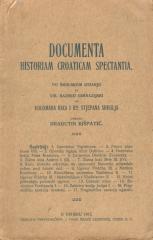
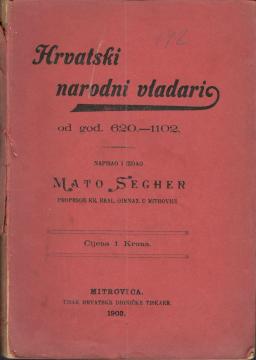
Hrvatski narodni vladari od god. 620.–1102.

Mate Sagher

A pioneering attempt at a systematic presentation of Croatian political history from the settlement of Croats to the conclusion of a personal union with Hungary. Segher chronologically traces the development of Croatian statehood, relying on the sources a

The work begins with a description of the arrival of the Croats in the territory of present-day Croatia around the 7th century, and the establishment of the early principalities. He places special emphasis on the rule of the princes of the Trpimirović dynasty, who consolidated power and laid the foundations of Croatian statehood. Segher discusses in detail the reign of King Tomislav, the first Croatian king, and his successors, including Petar Krešimir IV. and Dmitri Zvonimir.

The book also analyzes internal political struggles, relations with Byzantium, Frankishness, and Hungary, and the impact of church reforms on political stability. The final part of the work is dedicated to the period after the death of King Zvonimir, which was marked by dynastic conflicts and the weakening of central authority, which culminated in the conclusion of a personal union with Hungary in 1102.

Segher's work, although written in the spirit of the historiography of the time, remains an important source for understanding the formation of the Croatian medieval state. His approach combines a narrative style with analytical insights, making the book accessible and informative for a wider audience interested in Croatian history.

Dimensions
19 x 13 cm
Pages
104
Publisher
Dionička tiskara, Mitrovica, 1903.
 
Latin alphabet. Paperback.
Language: Croatian.

One copy is available

Condition:Used, very good condition
Damages or inconvenience notice:
  • Damaged back
 

Are you interested in another book? You can search the offer using our search engine or browse books by category.

You may also be interested in these titles

Hrvatsko proljeće

Hrvatsko proljeće

Miko Tripalo

The Croatian Spring is not only a chronicle of the events of 1971, but also a suggestive presentation of the political conditions of Yugoslavia in the post-war period. These testimonies come from the pen of a man who really tried to break the shackles of

Globus, 1990.
Croatian. Latin alphabet. Hardcover with dust jacket.
11.589.26 - 13.36
U Titovim pandžama (Svjedočanstva)

U Titovim pandžama (Svjedočanstva)

Vladislav Musa

The content of the book is real and experienced in the enslaved homeland, in the dictatorship and Tito's prisons.

Vlastita naklada, 1973.
Croatian. Latin alphabet. Paperback.
27.36
Stepinac

Stepinac

Živko Kustić
Studio promotion, 1991.
Croatian. Latin alphabet. Paperback.
4.82
S tradicionalnih na nove puteve: Trgovina, obrt, industrija i bankarske ustanove grada Osijeka na prijelazu stoljeća od 1868. do 1918. godine

S tradicionalnih na nove puteve: Trgovina, obrt, industrija i bankarske ustanove grada Osijeka na prijelazu stoljeća od 1868. do 1918. godine

Zlata Živaković-Kerže

The book explores the economic development of Osijek after the Croatian-Hungarian Settlement until the end of World War I. Osijek, as an important center of Slavonia, experienced a significant economic boom thanks to its location on the Drava River and th

Hrvatski institut za povijest, 1999.
Croatian. Latin alphabet. Hardcover.
7.325.86
Topografično-povijesne crte slobodnog kraljevskog grada Križevca

Topografično-povijesne crte slobodnog kraljevskog grada Križevca

Kvirin Vidačić

The book "Topographical-historical contours of the free royal city of Križevac" by Kvirin Vidačić is a reprint from 1886.

Matica hrvatska, 1993.
Croatian. Latin alphabet. Hardcover.
17.22
Slavonija & Baranja

Slavonija & Baranja

Zvonko Maković, Marin Topić

The purpose of this monograph is to show what Slavonia is really like in all its segments. It is the desire of the two authors to convey their love and sincere admiration for their immediate homeland to others.

MIT d.o.o., 2005.
Croatian. Latin alphabet. Hardcover.
20.96