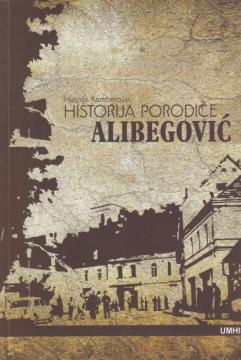
Historija porodice Alibegović: transformacija iz begovske zemljoposjedničke u modernu građansku porodicu

Historija porodice Alibegović: transformacija iz begovske zemljoposjedničke u modernu građansku porodicu

Husnija Kamberović

The book depicts the development of a Bosnian bey family that, throughout the 19th and 20th centuries, transformed from a landowning family into a modern bourgeois family, reflecting broader social changes in Bosnia and Herzegovina.

In the work History of the Alibegović Family: Transformation from a Bey Landowner to a Modern Bourgeois Family, historian Husnija Kamberović explores the centuries-long development of the distinguished Alibegović family, which originated from the Kobaška Captaincy. The book shows how social, economic and political circumstances in Bosnia and Herzegovina – from the Ottoman and Austro-Hungarian rule to the modern era – shaped the fate of the old Bey classes.

After the abolition of the captaincies, the Alibegovićs successfully transitioned from feudal to merchant class, developing new economic activities and adapting to changes that led many other noble families to ruin. The author analyzes their property, family networks and political activities, as well as relations with other important families such as the Gradaščevićs, the Pašićs and the Ibrahimpašićs through archival materials, correspondence and documents from the 19th century.

Kamberović’s work goes beyond a local study — it shows how the fate of the Alibegovićs is a mirror of the broader social transformation of the Bosnian Muslim elites. The book reflects the processes of modernization, national integration and cultural transition from the feudal to the civil era of Bosnia and Herzegovina.

Editor
Amir Duranović
Dimensions
24 x 17 cm
Pages
182
Publisher
Udruženje za modernu historiju (UMHIS), Sarajevo, 2021.
 
Latin alphabet. Paperback.
Language: Croatian.

One copy is available

Condition:Unused
 

Are you interested in another book? You can search the offer using our search engine or browse books by category.

You may also be interested in these titles

Snažan eho brionski: Odjeci Brionskog plenuma u Bosni i Hercegovini 1966. godine

Snažan eho brionski: Odjeci Brionskog plenuma u Bosni i Hercegovini 1966. godine

Amir Duranović

Amir Duranović's book reconstructs in detail the dramatic year 1966 and the Fourth (Brion) Session of the Central Committee of the Communist Party of Yugoslavia (July 1–2, 1966), at which Aleksandar Ranković, the long-time head of the UDB and vice preside

Udruženje za modernu historiju (UMHIS), 2017.
Croatian. Latin alphabet. Paperback.
9.54
Titostalgija

Titostalgija

Mitja Velikonja

The author explores why Tito remains a popular symbol of stability, social security and independence, despite critical views of his regime. The book maps the cultural, political and everyday manifestations of "Titostalgia".

Biblioteka XX vek, 2010.
Serbian. Latin alphabet. Paperback.
7.36
Doživljaji i putovanja do slobode

Doživljaji i putovanja do slobode

Vladimir Novak

The autobiographical work of Croatian communist activist Vladimir Novak, a survivor of the Ustasha camps, follows his memories of resistance to fascism during World War II.

August Cesarec, 1979.
Croatian. Latin alphabet. Hardcover with dust jacket.
8.26
Hrvatska u arhivima izbjegličke vlade 1941-1943.: Izvještaji informatora o prilikama u Hrvatskoj

Hrvatska u arhivima izbjegličke vlade 1941-1943.: Izvještaji informatora o prilikama u Hrvatskoj

Ljubo Boban

Academician Ljubo Boban, in his work Croatia in the Archives of the Government in Exile 1941–1943, brings together a collection of diplomatic reports from various European and international representative offices of the Yugoslav government in exile during

Globus, 1985.
Croatian. Latin alphabet. Hardcover with dust jacket.
9.526.66
Nacionalni testament kralja Aleksandra I

Nacionalni testament kralja Aleksandra I

Branislav M. Stepanović

The author presents the political and ideological legacy of King Aleksandar I Karađorđević the Unifier. The book, published immediately after the king's death, is an attempt to preserve and transmit his political ideals to future generations.

Jugoslovenska biblioteka "Bratstvo", 1936.
Serbian. Cyrillic alphabet. Hardcover.
28.36
Nacionalno pitanje

Nacionalno pitanje

Omladinski otsek Polit, 1946.
Serbian. Latin alphabet. Paperback.
28.96