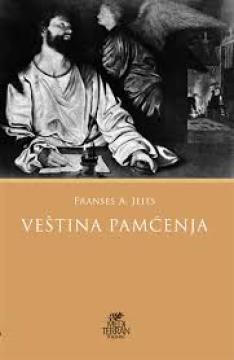
Veština pamćenja
Rare book

Veština pamćenja

Frances A. Yates

The Art of Memory (1966), one of the most significant works of intellectual history, explores the history of mnemonics from ancient Greece and Rome, through the Middle Ages and the Renaissance, to its influence on the science and culture of Europe.

The book is a groundbreaking study that shows how artificial memory (mnemonics) was essential before the invention of printing. It is based on a system of places (loci) and images (imagines) – the orator or scholar imagines a well-known architectural structure (house, theater, city) and places within it vivid, emotionally charged images that represent what needs to be remembered.

Yates traces the development of this technique from ancient Greece (the legend of Simonides of Ceos), through Roman rhetoricians (Cicero, Quintilian), medieval scholastics (Thomas Aquinas), and all the way to the Renaissance. Renaissance thinkers of particular note include Giulio Camillo with his Theatre of Memory, Ramon Llull and his system, and Giordano Bruno, who transformed mnemonics into an occult, hermetic, and magical system for achieving universal knowledge.

The book shows how the art of memory was far more than a simple rote learning technique – it profoundly influenced literature (Dante), theatre (Shakespeare's Globe), philosophy, science and occult traditions. Yates links the decline of this art with the emergence of the scientific method in the 17th century (Leibniz and others).

The work is written in an extremely readable manner, with rich erudition and original insights. It has become a classic that has opened a new field of research in cultural and intellectual history. It has influenced psychology, the history of science, literary theory and the contemporary interest in mnemonics (memory palace).

In the Croatian context, the book has attracted the attention of all those interested in the Renaissance, Hermeticism and the history of ideas. It represents a masterpiece of 20th-century intellectual history.

Original title
The Art of Memory
Translation
Radmila B. Šević
Editor
Žolt Lazar
Dimensions
20 x 14 cm
Pages
484
Publisher
Mediterran Publishing, Novi Sad, 2013.
 
Latin alphabet. Paperback.
Language: Serbian.

One copy is available

Condition:New
 

Are you interested in another book? You can search the offer using our search engine or browse books by category.

You may also be interested in these titles

Deset dijaloga o povijesti

Deset dijaloga o povijesti

Franjo Petrić
Otokar Keršovani, 1980.
Croatian. Latin alphabet. Hardcover.
11.65
Machiavelli i njegova politička nauka: O četiristotoj obljetnici državnikove smrti (1527-1927)

Machiavelli i njegova politička nauka: O četiristotoj obljetnici državnikove smrti (1527-1927)

Vinko Lozovina

The book Machiavelli and His Political Science by Vinko Lozovina, published in 1928 on the occasion of the 400th anniversary of the death of Niccolò Machiavelli, presents a comprehensive analysis of the life, works, and political thought of this Renaissan

Matica hrvatska, 1928.
Croatian. Latin alphabet. Hardcover.
9.36
O samoći i drugi ogledi

O samoći i drugi ogledi

Michel de Montaigne

Montaigne is considered the father of the essay (The Views were first published in 1580), a literary form that combines a scientific approach and the author's personal view of the subject.

Hoplit, 2023.
Serbian. Latin alphabet. Paperback.
8.97
Grad sunca

Grad sunca

Tommaso Campanella

The City of the Sun (Latin: Civitas Solis, published in 1623) is a visionary, esoteric, almost mystical utopia, deeply imbued with the Renaissance spirit, Egyptian astrology, and the Christian hope for a perfect society.

Kultura, 1964.
Serbian. Latin alphabet. Hardcover.
7.52
Utopija

Utopija

Thomas More

In Utopia, Thomas More depicts an imaginary perfect society located on an isolated island, where the ruling principles of harmony, equality and reason overcome the imperfections of European society at the time.

Kultura, 1964.
Serbian. Latin alphabet. Paperback.
6.34