Nalazište mlađeg željeznog doba s terena Osijeka (nastavak)
Rare book

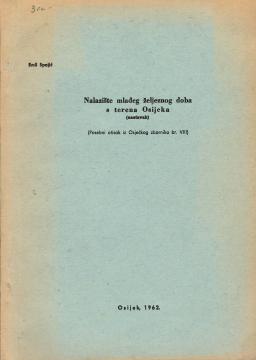
Nalazište mlađeg željeznog doba s terena Osijeka (nastavak)

Emil Spajić

The study analyzes the Celtic necropolis in Osijek, revealing the simultaneous use of cremation and burial of the deceased. The findings indicate strong Celtic and Illyrian cultural influences and developed metal production.

The study presents the results of the research of the Celtic cemetery in Osijek, which has been systematically investigated since 1958. Recent excavations have shown that two burial methods were used at the necropolis at the same time – cremation of the deceased and inhumation.

Single, double and circular graves with various offerings, most often swords and metal objects, were found. Particularly noteworthy are the astragal belts made of bronze links, characteristic of the Illyrian cultural circle, which confirms the strong connections between the Celtic and Illyrian traditions.

The number and diversity of metal finds exceed ceramic ones, which indicates a developed metallurgy, social stratification and a rich material culture of the population. The author concludes that the necropolis represents an important source for the study of funeral customs, cultural contacts and ethnic composition of the community in the Early Iron Age.

Illustrations
Dragutin Vukasović
Dimensions
24 x 17 cm
Pages
33
Publisher
Muzej Slavonije, Osijek, 1962.
 
Latin alphabet. Paperback.
Language: Croatian.

One copy is available

Condition:Used, excellent condition
 

Are you interested in another book? You can search the offer using our search engine or browse books by category.

You may also be interested in these titles

Izvještaj o nalazima keramike brončanog doba iz Kozarca

Izvještaj o nalazima keramike brončanog doba iz Kozarca

Emil Spajić

Emil Spajić's study presents the results of archaeological research at the Bronze Age site in Kozarac in Baranja and analyzes the settlement, cultural layer, and ceramic finds.

Muzej Slavonije, 1956.
Croatian. Latin alphabet. Paperback.
11.42
Kraj vremena: Revizija proročanstva Maya

Kraj vremena: Revizija proročanstva Maya

Adrian Gilbert

British author Adrian Gilbert (co-author of The Mayan Prophecies from 1995) in The End of Time offers the most thorough and sober modern interpretation of the Mayan calendar and the so-called "2012 prophecy", completely rejecting New Age hysteria.

Stari grad, 2009.
Croatian. Latin alphabet. Hardcover.
18.2212.75 - 18.2412.77
Uništenje Atlantide: Uvjerljiv dokaz o iznenadnoj propasti legendarne civilizacije

Uništenje Atlantide: Uvjerljiv dokaz o iznenadnoj propasti legendarne civilizacije

Frank Joseph

Frank Joseph (real name Francis Joseph Collin) presents in this book the most comprehensive modern defense of Plato's Atlantis as a real historical civilization that disappeared in a catastrophe around 1628–1600 BC.

Stari grad, 2004.
Croatian. Latin alphabet. Hardcover.
15.2410.67 - 15.2810.70
Prije potopa: Dokaz da je biblijski potop bio stvaran događaj

Prije potopa: Dokaz da je biblijski potop bio stvaran događaj

Ian Wilson

British historian Ian Wilson (known for his books on the Shroud of Turin and Jesus) offers the most thorough defense of the thesis that the biblical flood was a real historical event, not just a myth, in his work Before the Flood.

Stari grad, 2007.
Croatian. Latin alphabet. Hardcover.
16.2211.38 - 16.2812.18
Drevni tragovi: Tajne drevne povijesti i pretpovijesti

Drevni tragovi: Tajne drevne povijesti i pretpovijesti

Michael Baigent

In the book Ancient Traces, New Zealand author Michael Baigent (co-author of the bestseller Holy Blood, Holy Grail) presents the provocative thesis that the official history of humanity is incomplete and that there is a hidden, much older layer of civiliz

Stari grad, 2005.
Croatian. Latin alphabet. Hardcover.
15.2210.65 - 15.4215.36
Arktička pradomovina Veda

Arktička pradomovina Veda

Bal Gandahar Tilak

The book The Arctic Homeland of the Vedas (1903) by the Indian scholar Tilak proposed the hypothesis that the ancient Aryans, the authors of the Rigveda, originated in the Arctic region. Although controversial, the book remains important in the study of V

NIRO Književne novine, 1987.
Serbian. Latin alphabet. Paperback.
17.56