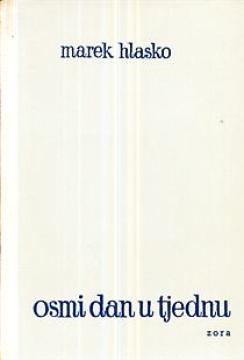
Osmi dan u tjednu
Through the story of young Agnieszka and her brother Grzegorz in Warsaw, Marek Hłasko depicts the hopeless everyday life, lost illusions and longing for a better tomorrow in the novel The Eighth Day of the Week.
The novel The Eighth Day of the Week (originally Ósmy dzień tygodnia) by Polish author Marek Hłasko—published in Croatian translation in 1960—is a powerful and melancholic work that offers an exceptionally sharp portrayal of the social reality and inner emptiness of post-war Warsaw. The narrative follows young Agnieszka, her brother Grzegorz, and her boyfriend Piotr as they navigate cramped living conditions, scarcity, and the emotional exhaustion of daily urban life—a world where illusions of happiness and a better future constantly collide with harsh reality. Through characters desperately seeking even a fleeting refuge, intimacy, or a glimmer of hope, Hłasko lays bare the moral apathy, disillusionment, and the crushing weight of a lack of prospects that burden the younger generation. The symbolic "eighth day of the week" represents a longing for a different, purer, and more just era—one that never seems to arrive amidst the rhythm of monotonous, arduous days. Written in a concise, uncompromising, and evocative style, the novel weaves together existential angst, bitterness, and genuine empathy for people pushed to the very limits of their endurance. The Eighth Day of the Week remains a quintessential example of Hłasko’s prose—painful, immediate, and enduringly poignant.
One copy is available
- The cover is missing
- Traces of patina