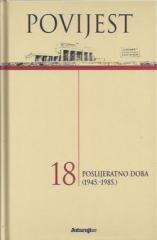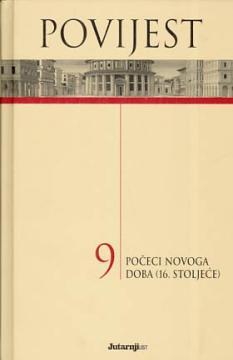
Povijest #9: Počeci novoga doba

Povijest #9: Počeci novoga doba

The ninth volume of the World History series covers the period of the 16th century, which marks the beginning of a new era, a kind of early modern age that brought great political, social, and cultural changes, and announced the creation of a new world.

The book focuses on the political, religious, economic, and cultural changes that shaped modern Europe. The Reformation, initiated by Luther's Theses (1517), split Christianity, giving rise to Protestantism and fueling conflicts such as the Schmalkaldic War. The Catholic Church responded with the Council of Trent, launching the Counter-Reformation and strengthening the Jesuits.

Geographical discoveries (Columbus, Cortés, Pizarro) expand the colonial power of Spain and Portugal, while the slave and resource trade changes the global economy. Mercantilism becomes dominant, and European monarchies (Charles V, Henry VIII) strengthen centralized authority. Renaissance arts flourish in Italy, while science develops through the work of Copernicus, Galileo, and Vesalius. The Ottoman Empire reaches its peak under Suleiman the Magnificent, threatening Europe.

In the Croatian context, the Turkish threat stands out, with the fall of Klis (1537) and the struggles of the Croatian nobility. The book is richly illustrated, providing a comprehensive overview of the 16th century through key events and personalities.

Prijevod
Noordkerk i Jelena Ivičević Desnica
Urednik
Ivo Goldstein i Enrico Cravetto
Ilustracije
Adom Macheroni
Dimenzije
22 x 14 cm
Broj strana
647
Nakladnik
Europapress holding, Zagreb, 2008.
 
Latinica. Tvrde korice.
Jezik: Hrvatski.
ISBN
978-9-53300-043-5

Dva primjerka su u ponudi

Primjerak broj 1

Stanje:Nekorišteno
Dodano u košaricu!

Primjerak broj 2

Stanje:Nekorišteno
Dodano u košaricu!
 

Zanima Vas i neka druga knjiga? Možete pretražiti našu ponudu pomoću tražilice ili prelistati knjige po kategorijama.

Možda će Vas zanimati i ovi naslovi

Uvod u podunavsko pismo

Uvod u podunavsko pismo

Harald Haarman

Introduction to the Danubian Script by Harald Haarmann (2010) is the first systematic introduction to the oldest writing system in Europe – the Old European or Danubian script (c. 5300–3200 BC), which emerged within the framework of the Danubian Civilizat

Akademska knjiga, 2022.
Srpski. Latinica. Tvrde korice.
20,00
Ilustrirana povijest svijeta 1-24

Ilustrirana povijest svijeta 1-24

The Illustrated History of the World is a lavishly illustrated encyclopedic series of 24 volumes. A total of 1,200 pages in hardcover, it provides a comprehensive overview of world history from prehistory to contemporary challenges, intended for education

24 sata, 2010.
Hrvatski. Latinica. Tvrde korice.
68,52
Velika enciklopedija za djecu: Povijest svijeta 1-2

Velika enciklopedija za djecu: Povijest svijeta 1-2

We will meet famous dynasties, great conquerors, military leaders and dictators who left their mark on history.

Europapress holding, 2007.
Hrvatski. Latinica. Tvrde korice.
Knjiga se sastoji od dva toma
5,004,00 - 9,00
Vikinzi

Vikinzi

Tony Allan

This book is a richly illustrated introduction to an exceptionally interesting people, known for their belligerence and conquering tendencies, but at the same time capable of enchanting craftsmanship and a mythological view of the world.

24 sata, 2001.
Hrvatski. Latinica. Tvrde korice.
6,00
Zagonetka podunavske civilizacije

Zagonetka podunavske civilizacije

Harald Haarman

Harald Haarmann's book presents the discovery of Europe's oldest highly developed culture (c. 5500–3500 BC), known as the Danube or Old European Civilization, with an emphasis on its writing, art and influence.

Akademska knjiga, 2019.
Hrvatski. Latinica. Broširano.
27,00
Ciklus svemirskih katastrofa: Potopi, požari i skapavanja u povijesti civilizacije

Ciklus svemirskih katastrofa: Potopi, požari i skapavanja u povijesti civilizacije

Richard Firestone, Allen West, Simon Warwick-Smith

The book is the most readable and complete overview of the evidence that human civilization has already been nearly wiped out of the universe once – and that such cycles may repeat themselves every few tens of thousands of years.

Stari grad, 2007.
Hrvatski. Latinica. Tvrde korice.
21,2214,94 - 21,3421,28