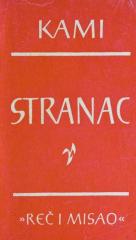

Stranac

Stranac

Albert Camus

The novel The Stranger (1942) is a work by French writer Albert Camus and a key text of existentialism and the absurd. The novel is written in a concise, almost monotonous style, which enhances the feeling of alienation.

The story follows Meursault, a young Frenchman in Algeria, whose indifferent attitude towards life and emotions reflects Camus's philosophy of the absurd – the idea that life has no inherent meaning, and that the human search for meaning often meets with emptiness.

The plot begins with the death of Meursault's mother. His emotional indifference at her funeral – he shows no grief, but notices the details of his surroundings – sets the tone for the novel. He returns to Algeria, where he resumes his routine life, embarks on a romantic relationship with Marie, and befriends his friend Raymond. The key event occurs on the beach, where Meursault, under the influence of heat and tension, kills an Arab for no apparent motive, leading to his arrest.

The second part of the novel focuses on the trial, where Meursault's indifference and inability to express remorse or moral reflection become central themes. He is condemned by society not only for the murder, but also for his rejection of conformity and emotional norms. In prison, Meursault contemplates life, death, and the absurd, accepting the indifference of the universe.

Original title
L"etranger
Translation
Mirjana Lalić
Dimensions
20 x 14 cm
Pages
109
Publisher
Svjetlost, Sarajevo, 1988.
 
Latin alphabet. Hardcover.
Language: Serbian.
ISBN
8-60-101198-5

Multiple copies are available

Copy number 1

Condition:Used, good condition (visible signs of use)
Damages or inconvenience notice:
  • Library stamp
  • Damaged back
  • Traces of patina
  • Pen/marker notes

Copy number 2

Condition:Used, condition good enough
Damages or inconvenience notice:
  • Library stamp
  • Damaged back
  • Slight damage to the cover

Copy number 3

Condition:Used, good condition (visible signs of use)
Damages or inconvenience notice:
  • Damaged covers
  • Library stamp

Copy number 4

Condition:Used, condition good enough
Damages or inconvenience notice:
  • Damaged covers
  • Library stamp
  • Damaged back
 

Are you interested in another book? You can search the offer using our search engine or browse books by category.

You may also be interested in these titles

Stranac

Stranac

Albert Camus

The Stranger is a novel by French writer and philosopher Albert Camus. Published in 1942, it is one of the most significant novels in twentieth-century French literature and one of the best literary depictions of the absurdity of human existence.

Znanje, 1980.
Croatian. Latin alphabet. Paperback.
5.62
Stranac

Stranac

Albert Camus

"The Stranger" (1942) by Albert Camus, a classic work of existentialism, follows the life of Meursault, an emotionally indifferent Algerian of French descent, whose apathetic attitude towards the world leads to tragic consequences.

Zora, 1951.
Croatian. Latin alphabet. Paperback.
13.46
Svilena klopka

Svilena klopka

Françoise Sagan

In The Silk Trap, Françoise Sagan depicts a love trap woven from passion, irony, and self-deception. Adrian, a cynical writer, is caught between success, boredom, and an elusive woman who changes his perspective on life.

Mladost, 1990.
Croatian. Latin alphabet. Hardcover with dust jacket.
4.98 - 7.36
Kleopatra: Egipatska kraljica

Kleopatra: Egipatska kraljica

Claude Ferval

The novel tells the lavish story of the last Egyptian queen, a woman of exceptional intelligence and beauty, whose life, love affairs with Caesar and Antony, and tragic death symbolize the collision of power, passion, and fate.

Alfa, 1985.
Croatian. Latin alphabet. Hardcover with dust jacket.
8.346.67
Pariški pokolj

Pariški pokolj

Jean Cassou
Naklada Binoza, 1936.
Croatian. Latin alphabet. Hardcover with dust jacket.
19.74 - 21.46
Pričaj im o bitkama, kraljevima i slonovima

Pričaj im o bitkama, kraljevima i slonovima

Mathias Énard

In 1506, Michelangelo Buonarroti was invited by Sultan Bayezid II to design a bridge across the Golden Horn in Constantinople. Furious at Pope Julius II who had humiliated him and refused to pay, Michelangelo left Rome and arrived by ship in Constantinopl

Profil Knjiga, 2012.
Croatian. Latin alphabet. Paperback.
7.44 - 7.46