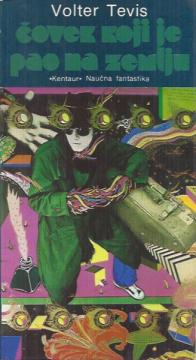
Čovek koji je pao na zemlju

Čovek koji je pao na zemlju

Walter Tevis

The Man Who Fell to Earth is a 1963 science fiction novel by American author Walter Tevis about an alien who lands on Earth looking for a way to transport his people to Earth from their home planet, which is suffering from a severe drought.

T. J. Newton is an alien who arrives on Earth with a desperate mission of salvation. But instead of help, Newton finds loneliness and despair that inevitably lead to a tragic end.

The novel served as the screenplay for Nicolas Roeg's film from 1976, as well as for the television adaptation from 1987 and the television series from 2022.

"Wonderful science fiction... A story about a visitor from another planet that more than anything speaks volumes about life on our own planet." —New York Times

Original title
The Man Who Fell to Earth
Translation
Vukica Đilas
Dimensions
21 x 12 cm
Pages
155
Publisher
Jugoslavija, Beograd, 1979.
 
Distribution: 8,000 copies
 
Latin alphabet. Paperback.
Language: Serbian.

Two copies are available

Copy number 1

Condition:Used, good condition (visible signs of use)
Damages or inconvenience notice:
  • Library stamp
  • Slight damage to the cover

Copy number 2

Condition:Used, excellent condition
 

Are you interested in another book? You can search the offer using our search engine or browse books by category.

You may also be interested in these titles

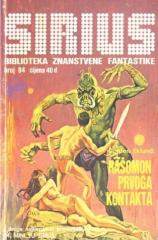
Sirius: Biblioteka znanstvene fantastike - broj 84

Sirius: Biblioteka znanstvene fantastike - broj 84

Gordon Eklund, Denis Ivković, Neven Jovanović, Stjepan Lubina, Gordan Momčilović, Dragan Nedeljko...

Sirius was a Croatian science fiction magazine. The foundation was proposed by Damir Mikuličić in 1976. In Sirius, the works of domestic authors, as well as translations of foreign SF authors, were published. It was published from 1976 to 1989.

Vjesnik, 1983.
Croatian. Latin alphabet. Paperback.
3.46
Slavna budućnost naše zemlje

Slavna budućnost naše zemlje

Mirko Golubić

The book is a genre of popular science literature with elements of technological vision and futurism, characteristic of the era in which it was created – the time of the Cold War, the space race, and great expectations from science.

Znaci vremena, 1972.
Croatian. Latin alphabet. Paperback.
2.98
Mačonoša

Mačonoša

John White

John Wilson was excited about his thirteenth birthday for two reasons: the first was that he would be greeted at home by his grandmother's delicious cake, and the second was that his grandmother would finally reveal the secret about his parents.

STEPress, 2002.
Croatian. Latin alphabet. Hardcover.
9.98
Moj prijatelj gospodin Leakey

Moj prijatelj gospodin Leakey

J. B. S. Haldane

J. B. S. Haldane (1892–1964), a British geneticist, evolutionary biologist, and science popularizer, wrote "My Friend Mr. Leakey" in 1937 – a collection of five humorous, fantastic stories for children (and adults).

Novo pokoljenje, 1950.
Croatian. Latin alphabet. Hardcover.
7.54
Primicanje katastrofa: Propasti koje prijete našem svijetu

Primicanje katastrofa: Propasti koje prijete našem svijetu

Isaac Asimov

A popular science work in which Asimov, combining scientific rigor with a lucid style, explores possible threats to the survival of humanity, systematizing disasters according to their nature and probability.

August Cesarec, 1981.
Croatian. Latin alphabet. Hardcover with dust jacket.
7.46
Čarobnjaci naših dana

Čarobnjaci naših dana

M. Iljin, E. Segal

"Magicians of Our Time" (1968) by M. Iljin and E. Segal is a popular science book that explains the development of science and technology in an understandable and interesting way.

Školska knjiga, 1968.
Croatian. Latin alphabet. Paperback.
3.66