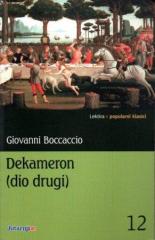
Dekameron

Dekameron

Giovanni Boccaccio

During the Great Plague of 1348, ten young Florentines flee to a villa and tell 100 stories over 10 days. Boccaccio's Decameron celebrates life, love, cunning, and human nature with humor and criticism of society.

The Decameron (1353) is one of the most important works of European literature and a masterpiece of Italian prose. It is considered the founder of modern novelistic literature and the most important work of early humanism.

The plot is set in Florence in 1348 during the terrible epidemic of the Black Death. Seven young women and three young men from noble families flee the city to a secluded villa in the vicinity. To pass the time, they agree to tell one story each day. Thus, 100 novels are created over ten days (hence the name Decameron = ten-day story).

The stories are extremely diverse: from tragic love stories, comic intrigues and deceptions, through erotic incidents, satirical stories about corrupt priests and monks, to philosophical and instructive tales. Boccaccio draws motifs from ancient literature, medieval fables, oral tradition, but also real life.

The most famous are the stories of Griselda, of Federigo and his falcon, of Andreucci of Perugia, and numerous humorous stories about deceived husbands and cunning women. The work celebrates human intelligence, vitality, the joy of life and carnal love in contrast to medieval asceticism and church hypocrisy.

Boccaccio wrote the Decameron in realistic, lively and conversational language, introducing bourgeois everyday life into high literature. His characters are full-blooded people with all the virtues and vices – cunning, greedy, brave, in love or vengeful. In this way, he significantly influenced later writers such as Chaucer (The Canterbury Tales), Shakespeare, Molière and many others.

Due to its free themes, the work was banned several times and placed on the Index librorum prohibitorum, but it still survived as one of the most widely read classics. Today it is considered a key transitional work from the Middle Ages to the Renaissance – a joyful, wise and fearless celebration of human nature.

Original title
Il Decameron
Translation
Jerka Belan, Mate Maras
Graphics design
Halid Malla
Dimensions
21 x 13 cm
Pages total
749
Publisher
Globus, Zagreb, 2004.
 
Latin alphabet. Paperback.
Language: Croatian.
ISBN
978-9-53716-043-2

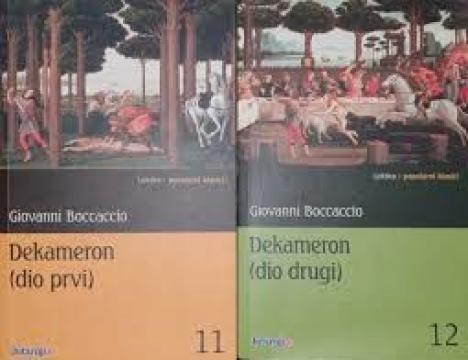
The book consists of two volumes.

Više primjeraka je u ponudi.

Copy number 1
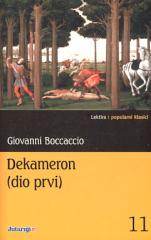
Dekameron
Volume 1
Pages: 399
Condition:Used, excellent condition
Dekameron
Volume 2
Pages: 351
Condition:Used, excellent condition

Copy number 2

Dekameron
Volume 1
Pages: 399
Condition:Used, excellent condition
Dekameron
Volume 2
Pages: 351
Condition:Used, excellent condition

Copy number 3

Dekameron
Volume 1
Pages: 399
Condition:Unused
Dekameron
Volume 2
Pages: 351
Condition:Unused
 

Are you interested in another book? You can search the offer using our search engine or browse books by category.

You may also be interested in these titles

Iz Dekamerona

Iz Dekamerona

Giovanni Boccaccio
Rad, 1962.
Serbian. Latin alphabet. Paperback.
0.99 - 2.56
Decameron i druga djela: izbor

Decameron i druga djela: izbor

Giovanni Boccaccio

Uz dvadeset novela iz Dekamerona, najvećeg djela talijanske pripovjedne proze, u ovoj su knjizi objavljeni i ulomci iz Rima, Filocola, Filostrata, Tezeide, Ameta, Elegije gospe Fiammette, Spjeva o fiezolanskim nimfama,Korbača i Raspravice u Pohvalu Danteu

Školska knjiga, 1989.
Croatian. Latin alphabet. Hardcover.
6.865.24 - 6.986.86
Barun Ivica

Barun Ivica

August Šenoa

Baron Ivica prikazuje raspad seljačke zadruge nakon ukidanja kmetstva. Baron Ivica, neozbiljan plemić, eksploatiše seljake, što dovodi do njihovog moralnog i materijalnog pada. Šenoa kritikuje prelazno društvo.

Hrvatsko književno društvo Sv. Jeronima, 1932.
Croatian. Latin alphabet. Hardcover.
6.34
U čarima strasti

U čarima strasti

Pavao M. Rakoš

"In the Charm of Passion" is a collection of short stories about love, longing, loss, and human relationships. Rakoš depicts the power of feelings, passion, and life's disappointments through different destinies.

Vlastita naklada, 1920.
Croatian. Latin alphabet. Paperback.
7.42
Pijanac

Pijanac

Mijat Stojanović

"The Drunkard" by Mijat Stojanović (1869) is a folk tale adapted from I. A. Stelzig. A moralistic story about the harmful effects of alcoholism, intended for the general public. A classic example of 19th-century enlightenment literature.

Hrvatsko književno društvo Sv. Jeronima, 1869.
Croatian. Latin alphabet. Hardcover.
32.46
Bura: novele

Bura: novele

Ferdo Čulinović

"Bura" (1928) is a collection of short stories by Ferdo Čulinović. Realistic stories inspired by the author's experience as a judge, with themes of social injustice, the common man, and turbulent social conditions in the Kingdom of Serbs, Croats, Slovenes

Knjižara Maričić i Janković, 1928.
Croatian. Latin alphabet. Paperback.
8.56