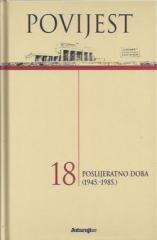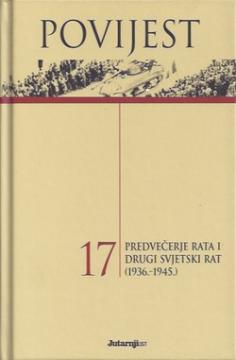
Povijest #17: Predvečerje rata i drugi svjetski rat

Povijest #17: Predvečerje rata i drugi svjetski rat

The seventeenth volume of the World History series covers the period from 1936 to 1945, focusing on the eve and course of World War II. The book provides a comprehensive account of the war's causes, course, and consequences, including the beginning of the

The global economic crisis of 1929 deepens political instability, fueling the rise of totalitarian regimes. Nazi Germany under Hitler, fascist Italy and militaristic Japan spread aggression. The Munich Pact (1938) and the policy of appeasement did not prevent the German annexation of Austria and the Sudetenland. The attack on Poland in 1939 starts the war.

The Second World War (1939–1945) was marked by global conflicts, the Holocaust and mass destruction. The Allies (USA, USSR, Britain) oppose the Axis Powers. Key battles, such as Stalingrad and Normandy, change the course of the war, which ends with the capitulation of Germany and the atomic bombing of Japan (1945). War brings millions of victims and changes the world order.

Culturally, the period is marked by propaganda art, while science advances through the development of nuclear weapons. In the Croatian context, the creation of the Independent State of Croatia (1941), collaboration with the Axis, the partisan movement led by Tito, and the liberation of Yugoslavia stand out.

Translation
Ana Badurina
Editor
Enrico Cravetto, Ivo Goldstein
Dimensions
21 x 14 cm
Pages
623
Publisher
Europapress holding, Zagreb, 2008.
 
Latin alphabet. Hardcover.
Language: Croatian.
ISBN
978-9-53300-054-1

No copies available

The last copy was sold recently.


Are you interested in another book? You can search the offer using our search engine or browse books by category.

You may also be interested in these titles

Dizanje prošlosti u vazduh: Ogledi o Balkanu i Istočnoj Evropi

Dizanje prošlosti u vazduh: Ogledi o Balkanu i Istočnoj Evropi

Marija Todorova

A collection of essays by the Bulgarian historian Maria Todorova (known for Imaginary Balkans), compiled especially for the 20th Century Library. Indispensable for understanding post-communist transitions, culture of memory and Balkan studies.

Biblioteka XX vek, 2010.
Serbian. Latin alphabet. Paperback.
8.44
Sudbonosni podvig Jugoslavije: Podsjećanje na historijsko NE staljinizmu, događaj koji je opredijelio budućnost Jugoslavije

Sudbonosni podvig Jugoslavije: Podsjećanje na historijsko NE staljinizmu, događaj koji je opredijelio budućnost Jugoslavije

Raif Dizdarević

The book by Raif Dizdarević, one of the last living actors of Yugoslav diplomacy, presents his reconstruction of the most fateful moment of post-war Yugoslavia – the split with Stalin and the Informburo in 1948–1953.

Udruženje za modernu historiju (UMHIS), 2018.
Croatian. Latin alphabet. Paperback.
23.58
Školstvo u XX. stoljeću

Školstvo u XX. stoljeću

The collection "Education in the 20th Century", published in 2003 in Annals for the History of Education (vol. 2), contains papers from the professional-scientific meeting in Zagreb (October 25-27, 2001), held on the occasion of the 100th anniversary of t

Hrvatski školski muzej, 2003.
Croatian. Latin alphabet. Paperback.
5.98
Na rubu revolucije - studenti '71.

Na rubu revolucije - studenti '71.

Tihomir Ponoš

This is the first book that comprehensively addresses the phenomenon of Croatian students and their role in the Croatian Spring. Students, along with the reform wing of the League of Communists and Matica Hrvatska, were one of the three pillars of the Cro

Profil International, 2007.
Croatian. Latin alphabet. Paperback.
9.56
Komunisti Jugoslavije 1919-1979.

Komunisti Jugoslavije 1919-1979.

Pero Morača, Stanislav Stojanović

The book provides an overview of the history of the Communist Party of Yugoslavia (KPJ) from its founding to the late 1970s, emphasizing its role in the revolution, self-government, and construction of Yugoslavia, with an ideologically colored perspective

Eksportpres, 1979.
Serbian. Latin alphabet. Hardcover with dust jacket.
11.988.99
Bormannova braća idu dalje

Bormannova braća idu dalje

William Stevenson

The book reveals the secret network through which Martin Bormann, Hitler's treasurer, ensured the survival of Nazi power and capital after the fall of the Third Reich.

Vjesnik, 1977.
Croatian. Latin alphabet. Hardcover.
6.54