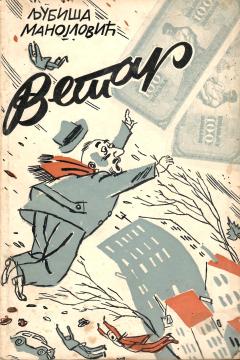
Vetar
A collection of short stories and humor by the long-time editor of the satirical newspaper "Jež", in which human weaknesses, social absurdities and the mentality of the post-war era are revealed through satire, irony and humorous twists.
Vetar is a collection of short stories, humorous and satirical writings by Ljubiša Manojlović (1913–1991), a writer, journalist and long-time editor of the satirical newspaper Jež. As one of the most prominent authors of Yugoslav humorous and satirical literature, Manojlović combined journalistic insight, humor and social criticism in his works.
The stories in the collection focus on everyday life and ordinary people. Through a series of short, humorously crafted situations, the author depicts human weaknesses, vanity, conformity, bureaucratic absurdities and other phenomena characteristic of the society of his time. Humor arises from character and circumstances, while irony and satire serve as a means of critical observation of social relations.
Vetar was written during the author's period of creative maturity, when he also published other notable works such as Hijavatin Knot and the novel Meteor sa žutom mašnom. The collection well represents the fundamental features of his oeuvre: short form, clarity of expression, a penchant for humor, and an interest in social themes.
The first edition of the book was illustrated by Dragan Savić, a prominent cartoonist associated with the tradition of Ošišani jež and Jež. As one of the representatives of the golden age of Serbian comics and later the author of the Belgrade mascot “dživdžan”, Savić successfully complemented Manojlović’s satirical expression with his illustrations. The collaboration between the two authors symbolically connects literary humor and caricature, two key forms of social criticism that marked the circle gathered around Jež.
Today, Vetar is interesting not only as a collection of humoresques, but also as a testimony to an important cultural circle in which satire and humor served as a space for critical reflection on society. This dimension is especially important in light of Manojlović’s later fate: after political attacks in 1968, he was removed from his position as editor-in-chief of Jež, and his works were suppressed and rarely published for years.
Despite this, Manojlović remained one of the most significant representatives of Yugoslav satirical literature, and Vetar one of the representative works of his most prolific creative period.
One copy is available
- Traces of patina