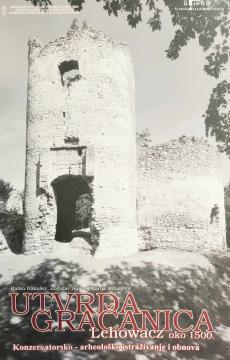
Utvrda Gračanica lehowacz oko 1500.

Utvrda Gračanica lehowacz oko 1500.

Ratko Ivanušec, Marija Mihaljević, Zvonko Bojčić, Zorislav Horvat

Conservation - archaeological research and restoration

The Gračanica-Lehowacz fortress, not far from the village of Baćin Dol and the settlement of Cernik in western Slavonia, is one of the many medieval forts in continental Croatia, the structure of which was destroyed during the Turkish wars of conquest in the first half of the 16th century, but also later in the wars of liberation against the Turks towards the end 17th century Gračanica-Lehowacz fortress was built on the property of the Desislavić noble family at the end of the 15th century or around 1500 in the form of a refuge, that is, a fortress that served as protection against the coming Turkish threat. In that period, the oval-shaped fort consisted of an entrance three-story tower and a perimeter wall with a bastion. A palas was located in the interior along the western perimeter wall. The conservation analysis of the architectural structure of the fort and the findings of preliminary archaeological research have contributed to some new knowledge and views on the architectural layering of the site. Inside the fort, the walls of older fortification complexes dating back to the 13th and 14th centuries were discovered. Of the complete fortification complex of the late medieval fort, the entrance tower, which lacks the third floor and roof, has been preserved to a greater extent, as well as the eastern oval wall and partially the back side of the perimeter wall. .

Editor
Ratko Ivanušec, Marija Mihaljević
Dimensions
23 x 16.5 cm
Pages
39
Publisher
Gradski muzej, Nova Gradiška, 2011.
 
Distribution: 500 copies
 
Latin alphabet. Paperback.
Language: Croatian.
ISBN
978-9-53950-128-8

No copies available

The last copy was sold recently.
 

Are you interested in another book? You can search the offer using our search engine or browse books by category.

You may also be interested in these titles

Toma Splićanin - državnik i pisac (1200.-1268.): njegovo život i njegovo djelo

Toma Splićanin - državnik i pisac (1200.-1268.): njegovo život i njegovo djelo

Cherubin Šegvić

The first comprehensive monograph on Thomas the Archdeacon, a 13th-century Split cleric, chronicler, and statesman. The work represents a significant contribution to Croatian historiography, providing insight into the life and work of one of the key figur

Matica hrvatska, 1927.
Croatian. Latin alphabet. Hardcover.
12.568.79
Stjepan Radić

Stjepan Radić

The Stjepan Radić exhibition catalogue, published in 1991 on the occasion of the exhibition at the Croatian History Museum in Zagreb, is dedicated to the life and work of Stjepan Radić (1871–1928), a key figure in Croatian politics and the founder of the

Hrvatski povijesni muzej, 1991.
Croatian. Latin alphabet. Paperback.
6.42
Bošković – kalendar Hrvatskog prirodoslovnog društva

Bošković – kalendar Hrvatskog prirodoslovnog društva

Calendar dedicated to Ruđer Josip Bošković on the occasion of the 200th anniversary of his birth. Published in 1919 in Zagreb, the calendar provides an overview of Bošković's life and work, emphasizing his role in mathematics, astronomy, physics and philo

Hrvatsko prirodoslovno društvo, 1919.
Croatian. Latin alphabet. Paperback.
7.46
Historical Maps of Croatia

Historical Maps of Croatia

From The Penguin Atlas of World History that offers a unique combination of maps and illustrations with detailed chronological summary.

Croatian Information Centre, 1993.
English. Latin alphabet. Paperback.
11.227.85
Hrvatska borba za opstojnost 1918.-1998.

Hrvatska borba za opstojnost 1918.-1998.

Milivoj Kujundžić, Zdravko Dizdar

The book contains an account of the history of Croatia from 1918 to 1998 in four historical periods (1918-1941; 1941-1945, 1945-1990 and 1990-1998).

Hrvatski državni sabor, 2000.
Croatian. Latin alphabet. Hardcover.
6.424.81
Jugoslavenske vlade u izbjeglištvu 1941-1943

Jugoslavenske vlade u izbjeglištvu 1941-1943

Bogdan Krizman, Branko Petranović

A two-volume work that documents the activities of Yugoslav governments in exile during World War II. The study represents a significant contribution to the study of the history of political processes during World War II.

Globus, 1981.
Croatian. Latin alphabet. Hardcover with dust jacket.
The book consists of two volumes
12.99