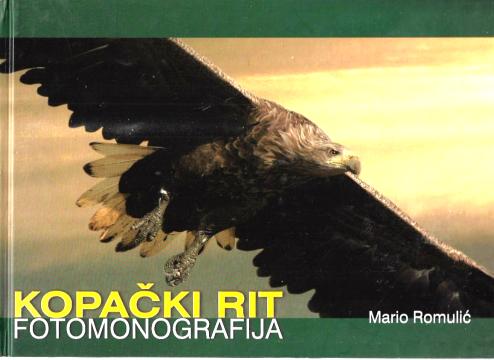
Kopački rit (fotomografija)

Kopački rit (fotomografija)

Mario Romulić

Kopački rit Nature Park, home to numerous, even endangered and rare animal species, is a great challenge for photographers, so the published photo monograph is not only a reward, but also a source of pride.

Kopački rit Nature Park was founded in 1967, and is located in the northeastern part of the Osijek-Baranja County, where Croatia borders Serbia. It is a flood valley and an internal delta of a large and very powerful river in the shape of an angle that the Danube forms with one of its most important tributaries, the Drava River, which flows into the Danube near Aljmaš downstream from Osijek. West of the flood valley at an elevation of between eight and ten meters is the very old village of Kopačevo (Kopŕcs), which is mentioned in the sources as early as 1212. The whole flood valley is called Kopački rit after the name of the village, after the Hungarian word rit, bog, baruština (mocsár), i.e. marshy, boggy and swampy region (mocsaras, mocsaras vidék).

Translation
Romana Čačija
Editor
Jozsef Mikuska
Graphics design
Igor Balen, Romulić d.o.o.
Dimensions
21.5 x 31 cm
Pages
200
Publisher
Romulić d.o.o., Osijek, 2003.
 
Distribution: 2,000 copies
 
Latin alphabet. Hardcover.
Language: Croatian.
ISBN
9-53-993932-1

One copy is available

Condition:Used, excellent condition
 

Are you interested in another book? You can search the offer using our search engine or browse books by category.

You may also be interested in these titles

Ljubo de Karina

Ljubo de Karina

Berislav Valušek

Ljubo de Karina (born 1948 in Rakalj, Istria) is a Croatian sculptor known for his monumental works in stone, especially Istrian limestone, but also bronze and wood.

Moderna galerija, 1997.
Croatian. Latin alphabet. Paperback.
9.98
Hrvatska

Hrvatska

Illustrated atlas

Naklada Zadro, 2005.
Croatian. Latin alphabet. Hardcover with dust jacket.
8.94
Knjiga o Srebrenici – spomenar jednog grada

Knjiga o Srebrenici – spomenar jednog grada

Sadik Salimović

Sadik Salimović's Book of Srebrenica (2002) is a memoir of the city: from Ottoman settlement, Islamization and development to the war suffering of 1992–1995 and genocide. It preserves the identity and memory of life before and after the tragedy.

Skupština opštine Srebrenica, 2002.
Croatian. Latin alphabet. Paperback.
11.32
Split

Split

Jure Kaštelan, Duško Kečmenet, Joško Carević

Split is a true tourist paradise. Its squares, streets and buildings showcase a wide range of styles.

Grafički zavod Hrvatske (GZH), 1970.
Croatian. Latin alphabet. Hardcover with dust jacket.
11.989.58
Agrokor: Slom ortačkog kapitalizma

Agrokor: Slom ortačkog kapitalizma

Martina Dalić

The story about events that took place with great intensity during a relatively short period of time - from February 2017 to May 2018 (events related to Agrokor, the largest Croatian company in the region).

Jutarnji list, 2018.
Croatian. Latin alphabet. Paperback.
3.22 - 4.35
Historija porodice Alibegović: transformacija iz begovske zemljoposjedničke u modernu građansku porodicu

Historija porodice Alibegović: transformacija iz begovske zemljoposjedničke u modernu građansku porodicu

Husnija Kamberović

The book depicts the development of a Bosnian bey family that, throughout the 19th and 20th centuries, transformed from a landowning family into a modern bourgeois family, reflecting broader social changes in Bosnia and Herzegovina.

Udruženje za modernu historiju (UMHIS), 2021.
Croatian. Latin alphabet. Paperback.
18.52