Poezija

Poezija

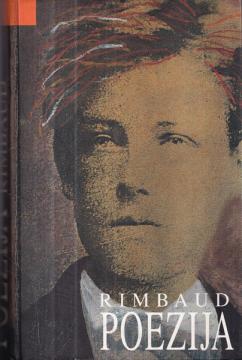
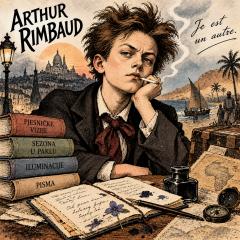
Arthur Rimbaud

The 'riddle of Rimbaud' was pursued by many: some proclaimed him the god of modern visionary poetry, others saw in him a perverted child and the immature rebellion of a high school student, others christened him a mystic, others treated him as an interest

Rimbaud's poetic reflection and writing are not behind us, perhaps they are just beyond the reach of the typical "horizon of expectations" of contemporary mass culture. They are not only the treasure of a great ancestor of 20th century poetry, stored in the museum of modern literature, but also a warning worthy of the greatest attention. An inspiration at least for those readers and writers of today who do not blindly or opportunistically accept the modern rules of the game. It is true that Rimbaud - the man, after he fell silent, submitted to the rules of the game of his time. But he left him as a pledge a work of irrefutable future charge

"Poetry will no longer rhythm the action, it will take the lead." (A. Rimbaud in a letter to P. Demeny, May 15, 1871)

"What is my nothingness compared to amazement

that awaits you." (A. Rimbaud, Illuminations)

Exalted and denied, for some an icon, for others a psychopath, this cursed poet remains in any case a lyrical phenomenon to whom all modern poetic currents owe a lot. Rimbaud's poetry is presented in a selection and translation by the famous Croatian poet, critic and translator Zvonimir Mrkonjić.

Translation
Zvonimir Mrkonjić
Editor
Nada Gašić
Graphics design
Svjetlan Junaković
Dimensions
20 x 13 cm
Pages
353
Publisher
Konzor, Zagreb, 1997.
 
Latin alphabet. Hardcover.
Language: Croatian.
ISBN
978-9-53631-745-5

No copies available

The last copy was sold recently.

 

Are you interested in another book? You can search the offer using our search engine or browse books by category.

You may also be interested in these titles

Robijaši, kolonisti i kanaci

Robijaši, kolonisti i kanaci

Georges Ferre

Convicts, Colonists and Kanaks is a powerful story about life in a French penal colony, which explores justice, freedom and colonial exploitation through the fates of convicts, colonists and Kanaks, while criticizing the dehumanizing system.

Binoza, 1933.
Croatian. Latin alphabet. Hardcover with dust jacket.
7.526.02
Moloa

Moloa

Samuel Beckett

The novel Molloy (1951) is the first part of Beckett's famous trilogy, along with Malone Dies and The Nameless. It is structured in two parts, each told from the perspective of a different narrator: first Molloy, then Jacques Moran.

Kosmos, 1959.
Serbian. Latin alphabet. Hardcover.
8.46
Kad župniku prekipi

Kad župniku prekipi

Jean Mercier

Benjamin: the parishioners in charge of flower arrangements on the altars are gossiping and arguing with each other, someone has messed up the confessional, and a few believers have started a petition against him.

Verbum, 2017.
Croatian. Latin alphabet. Hardcover.
5.28
Bartolomejska noć: knjiga 1-2

Bartolomejska noć: knjiga 1-2

Alexandre Dumas

This book focuses on one of the bloodiest events in French history – St. Bartholomew's Day in 1572, when thousands of French Protestants were massacred in Paris and across the country.

Epoha, 1966.
Croatian. Latin alphabet. Hardcover with dust jacket.
The book consists of two volumes
9.36
Dunda i druge novele

Dunda i druge novele

Guy de Maupassant

The story is set during the Franco-Prussian War (1870–1871), and begins with the escape of French citizens from Rouen, under Prussian occupation. Among them is Elizabeth Rousset, "Dunda", a girl of easy morals but a kind heart.

Veselin Masleša, 1971.
Serbian. Latin alphabet. Hardcover with dust jacket.
52.36 (set)