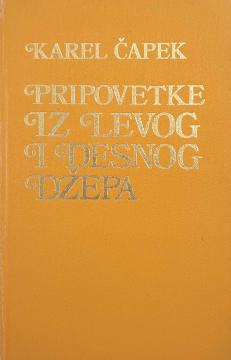
Pripovetke iz levog i desnog džepa

Pripovetke iz levog i desnog džepa

Karel Čapek

These stories deal with different topics, although most deal with different criminal acts, from fraud and fortune-telling to marriage fraud and murder.

However, these are not typical crime-genre stories, because even when investigators, police officers or judges appear in them, it is about ordinary officials who perform their work routinely, without excessive, bombastic actions. In their daily dealings with the activities of people who are at the bottom of the social ladder, these representatives of the state government behave differently without hiding sympathy or intolerance towards clients, they are willing to slack off or, grumpy and in a bad mood, delay their duties. Hence, there is no pomp in doing the job. There is not much imposingness even in stories that are not related to crime but to unusual, sometimes trivial situations. Almost all the stories are narrated by the participant of the event, post festum, to the audience (which mostly does not interfere in his monologue), which allows the speakers to stray from the basis of the topic and spice up the events with their philosophical views or speculations; so the entire presentation sometimes comes down to an anecdote with an unexpected twist, but sometimes it becomes an insightful study of character and fate.

Original title
Povidky zjedne kapsy, povidky z druhe kapsy
Translation
Vida Ljacka, Olga Šafarik
Editor
Milorad Najdanović
Dimensions
20.5 x 13.5 cm
Pages
250
Publisher
Jugoslavijapublik, Beograd, 1980.
 
Latin alphabet. Hardcover.
Language: Croatian.

One copy is available

Condition:Used, excellent condition
 

Are you interested in another book? You can search the offer using our search engine or browse books by category.

You may also be interested in these titles

Rat ljudi i daždevnjaka

Rat ljudi i daždevnjaka

Karel Čapek
Beogradski grafičko-izdavački zavod, 1975.
Serbian. Latin alphabet. Paperback.
2.99
Prva smjena

Prva smjena

Karel Čapek
Nakladno poduzeće Glas rada, 1952.
Croatian. Latin alphabet. Paperback with dust jacket.
4.99
Treće lice jednine

Treće lice jednine

Nedžad Maksumić

The third person singular is a very complicated and somewhat tricky stylistic device because all the characters in the novel are actually the author himself, and none of them are.

Buybook, 2018.
Croatian. Latin alphabet. Paperback.
10.987.69
Četrdeset pet vitezova, sv. 1-2

Četrdeset pet vitezova, sv. 1-2

Alexandre Dumas

Alexandre Dumas – The Forty-Five Knights, published in 1966, is part of a grand trilogy about the political and religious turmoil in France during the late 16th century.

Epoha, 1966.
Croatian. Latin alphabet. Hardcover with dust jacket.
The book consists of two volumes
9.48
I ne reče ni reči

I ne reče ni reči

Heinrich Böll

In Boll's novels, one of the central themes is the attempt to preserve basic moral values ​​in a time of terror, as well as in a period of material prosperity and corruption.

Svjetlost, 1965.
Serbian. Latin alphabet. Paperback.
3.22 - 3.98
Zlatarovo zlato

Zlatarovo zlato

August Šenoa

The first Croatian historical novel, the story of the forbidden love of a goldsmith's daughter and a nobleman's son on the historical stage of the streets and squares of Zagreb in the sixteenth century.

Tipex, 1994.
Croatian. Latin alphabet. Paperback.
9.98