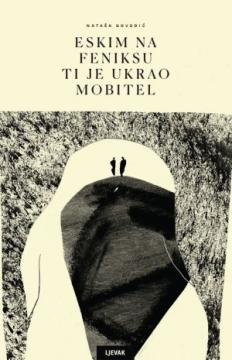
Eskim na feniksu ti je ukrao mobitel

Eskim na feniksu ti je ukrao mobitel

Nataša Govedić

An Eskimo na Fenix ​​stole your mobile phone is the second novel by Nataša Govedić, and it brings an intimate story of two protagonists and a dedication to the personal image of Zagreb.

Do you remember that tiny, yet very earnest inner voice that kept coming back to your most personal pleasure - fearing that you would forever bury it, sink it, lose it, burn it or just leave it at a gas station, as a useless surplus? Here he is again. He jumps over the fence and enters the backyard, where Kreda and Izak are sitting on the floor next to the hedge. Protagonists. At the same time, romance novels and intimate novels should not be confused. This one here is intimate. That's why he really needs ninety dimensions of our existence, and Eskimos and phoenixes no less.

Eros is not a slave to conventions.

At the same time, it is a novel about the city of Zagreb, but told from the perspective of walking, stepping, and physically moving through the streets between Sljemen and Hendrix Bridge. The aversion that Kreda feels towards the Faculty of Philosophy is at the same time a resistance to the bureaucratic concept of learning, studying and later useless work. No one wants to delay anything in this text and its world. On the contrary. Neither in love, nor in painting, nor in literature is there a better choice than... "traves". The novel brings a special edition of the fanzine Noćna straža, where twenty artists, gathered around the protagonist, exhibit their visual works on the theme of time, not the one from nine to five (the company) nor the one from zero to twenty-four (the supermarket). This art addition to the "art novel" is especially intended for readers who want to build themselves a small balcony-time or garden-time, as well as readers who do not need to build walls between pictures and text in the space of their imagination. Pictures of time in today's "time of pictures" also appear as proof that neither time nor pictures have been wasted.

Editor
Nenad Rizvanović
Graphics design
Klasja Habjan
Dimensions
21 x 14 cm
Pages
368
Publisher
Naklada Ljevak, Zagreb, 2023.
 
Latin alphabet. Hardcover with dust jacket.
Language: Croatian.
ISBN
978-9-53355-682-6

One copy is available

Condition:Unused
 

Are you interested in another book? You can search the offer using our search engine or browse books by category.

You may also be interested in these titles

Zlice i vilice

Zlice i vilice

Nataša Govedić
Fraktura, 2022.
Croatian. Latin alphabet. Hardcover with dust jacket.
14.50
Pasja kola

Pasja kola

Nataša Govedić

Nataša Govedić's new book of poetry owes its title, as well as its spine – upright and directly opposed to the associated symbolic field – to the ethics and aesthetics of cursing. However, her settings are more complex than those of the domestic progenito

V.B.Z, 2024.
Croatian. Latin alphabet. Hardcover.
11.38
Uskrsnuće

Uskrsnuće

Lav N. Tolstoj

In his last great novel, Resurrection (1899), Tolstoy combines literary artistry with profound moral and philosophical reflections, making it a key work of his late oeuvre.

Matica hrvatska, 1948.
Croatian. Latin alphabet. Hardcover.
4.56
Putevi nesreće IV: Čovek od gipsa

Putevi nesreće IV: Čovek od gipsa

Joseph Kessel

The final part of the Paths of Misfortune tetralogy. Richard Dalleau, broken by losses, drugs and internal conflicts, faces the consequences of his turbulent life and seeks salvation in despair and remorse.

Minerva, 1959.
Serbian. Latin alphabet. Hardcover.
7.58
Gorski car

Gorski car

Svetolik Ranković

In the novel Gorski car, which takes place in the countryside, Ranković also describes an event from his own life: while he was on summer vacation in 1886, bandits attacked his family home and killed his father Pavle, while torturing his mother and others

Džepna knjiga, 1953.
Croatian. Latin alphabet. Paperback.
4.50
Autobiografija

Autobiografija

Branislav Nušić

Branislav Nušić, the famous Serbian comedian, wrote his autobiography, which takes us through his life path. Through the eyes of Nušić, we follow his path from humble childhood to a successful literary career, imbued with humor and irony.

Džepna knjiga, 1955.
Croatian. Latin alphabet. Paperback.
4.55