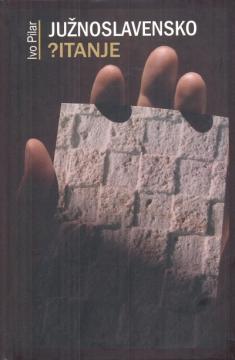
Južnoslavensko pitanje: Prikaz cjelokupnog pitanja

Južnoslavensko pitanje: Prikaz cjelokupnog pitanja

Ivo Pilar

Reprinted edition of the Croatian translation of publicist and politician Ivo Pilar's book "The South Slav Question", originally published in German in Vienna in 1918. With a foreword by Slobodan P. Novak.

The book of dr. Ive Pilara - The South Slavic question is the only systematically written judgmental view of the origin of the Great Serbian conquest idea. Pilar's book is a systematic and comprehensive, historically objective breakdown of the Great Serbian imperial idea, its genesis, its goals, its method. The book is of real textbook value in the most positive sense of the word, and those who were lucky enough to get their first thorough knowledge about it, and about Croatian-Serbian relations in general during the last 140-150 years, drew from it, and based their orientation on the knowledge that she provided them, they were spared from many delusions and wanderings, to which the others were condemned, whose thoughts and beliefs were formed by the writers of the Yugoslav-Serbophile orientations, which were extended in the first, royal Yugoslavia, and even only possible in the second, Tito-communist Yugoslavia.

Original title
Die südslawische Frage und der Weltkrieg. Uebersichtliche Darstellung des Gesamt – Problems
Translation
Fedor Pucek
Editor
Dražen Švagelj
Graphics design
Boris Ljubičić
Dimensions
24 x 15 cm
Pages
518
Publisher
Matica hrvatska, Vinkovci, 2017.
 
Latin alphabet. Hardcover.
Language: Croatian.
ISBN
978-9-53812-705-2

No copies available

The last copy was sold recently.
 

Are you interested in another book? You can search the offer using our search engine or browse books by category.

You may also be interested in these titles

Ljubljana u borbi 1941–1945: Zbornik sećanja

Ljubljana u borbi 1941–1945: Zbornik sećanja

The collection brings together the memories of participants in the national liberation struggle in Ljubljana during World War II. The collection contains personal testimonies, which provide insight into the everyday life, struggle and sacrifices of the in

Vojnoizdavački zavod, 1978.
Serbian. Latin alphabet. Hardcover with dust jacket.
9.76
I drugi su pjevali o ratu: Odjeci raspada Jugoslavije u engleskoj i američkoj književnosti

I drugi su pjevali o ratu: Odjeci raspada Jugoslavije u engleskoj i američkoj književnosti

Muharem Bazdulj

In this book of essays, Muharem Bazdulj analyzes how the collapse of Yugoslavia and the wars of the 1990s resonated in Anglo-Saxon literature – from pre-war stereotypes to war and post-war depictions.

Biblioteka XX vek, 2013.
Croatian. Latin alphabet. Paperback.
8.24
Titostalgija

Titostalgija

Mitja Velikonja

The author explores why Tito remains a popular symbol of stability, social security and independence, despite critical views of his regime. The book maps the cultural, political and everyday manifestations of "Titostalgia".

Biblioteka XX vek, 2010.
Serbian. Latin alphabet. Paperback.
7.36
Izabrani radovi

Izabrani radovi

Ljubo Boban

Selected Works of Academician Ljubo Boban (2022) brings together key texts on contemporary Croatian history of the 20th century. The foreword by Damir Agičić highlights Boban's methodological rigor and objectivity in researching sensitive topics.

Srednja Europa, 2022.
Croatian. Latin alphabet. Hardcover.
24.52
Komunisti Jugoslavije 1919-1979.

Komunisti Jugoslavije 1919-1979.

Pero Morača, Stanislav Stojanović

The book provides an overview of the history of the Communist Party of Yugoslavia (KPJ) from its founding to the late 1970s, emphasizing its role in the revolution, self-government, and construction of Yugoslavia, with an ideologically colored perspective

Eksportpres, 1979.
Serbian. Latin alphabet. Hardcover with dust jacket.
11.98
Historija porodice Alibegović: transformacija iz begovske zemljoposjedničke u modernu građansku porodicu

Historija porodice Alibegović: transformacija iz begovske zemljoposjedničke u modernu građansku porodicu

Husnija Kamberović

The book depicts the development of a Bosnian bey family that, throughout the 19th and 20th centuries, transformed from a landowning family into a modern bourgeois family, reflecting broader social changes in Bosnia and Herzegovina.

Udruženje za modernu historiju (UMHIS), 2021.
Croatian. Latin alphabet. Paperback.
18.52