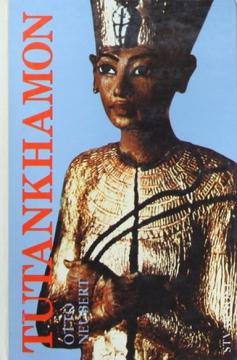
Tutankhamon: Kralj u zlatnim kovčezima

Tutankhamon: Kralj u zlatnim kovčezima

Otto Neubert

The author, one of the living eyewitnesses of the excavations in the Valley of the Kings, provides the reader with a popular-scientific picture not only of one of the most famous ancient Egyptian rulers, but also of the most interesting facts of the ethno

The work explores in detail the life and legacy of Pharaoh Tutankhamun and the discovery of his tomb. Neubert, who personally witnessed the excavations in the Valley of the Kings, provides readers with a popular-scientific account of Egyptian history, with special emphasis on Tutankhamun's reign and the cultural context of the period.

The book also covers the most interesting ethnological, political and sociological aspects of the era, providing readers with a broader picture of ancient Egyptian civilization. Although the work was written several decades ago, it provides valuable insight into the understanding of Egyptian history and archaeology at that time. For those who want to explore ancient Egyptian civilization and the discovery of one of the most famous pharaonic tombs, this book is an interesting read.

Original title
Tut-ench-amun: Gott in goldenen Särgen
Translation
Klara Dušanović
Dimensions
20 x 14 cm
Pages
216
Publisher
Stvarnost, Zagreb, 1977.
 
Latin alphabet. Hardcover.
Language: Croatian.

One copy is available

Condition:Used, excellent condition
 

Are you interested in another book? You can search the offer using our search engine or browse books by category.

You may also be interested in these titles

Otisci bogova: Potraga za početkom i krajem

Otisci bogova: Potraga za početkom i krajem

Graham Hancock

Hancock's evidence reveals not only the clear footprints of an unknown civilization that flourished during the last ice age, but also the terrifying truth about the scale of the catastrophe that wiped out almost all traces of it.

Stari grad, 2002.
Croatian. Latin alphabet. Hardcover.
19.22 - 19.36
Armagedonske bitke: Megido i Jizreelska dolina od Brončanoga do Nuklearnoga doba

Armagedonske bitke: Megido i Jizreelska dolina od Brončanoga do Nuklearnoga doba

Eric H. Cline

The book by a world-renowned archaeologist and historian explores Megiddo (Hebrew: Har Megiddo, Greek: Armageddon) and the Jezreel Valley as the bloodiest battlefield in world history. Over 4,000 years, 34 major battles were fought in this strategic pass.

Stari grad, 2005.
Croatian. Latin alphabet. Hardcover.
13.22 - 13.36
Drevni tragovi: Tajne drevne povijesti i pretpovijesti

Drevni tragovi: Tajne drevne povijesti i pretpovijesti

Michael Baigent

In the book Ancient Traces, New Zealand author Michael Baigent (co-author of the bestseller Holy Blood, Holy Grail) presents the provocative thesis that the official history of humanity is incomplete and that there is a hidden, much older layer of civiliz

Stari grad, 2005.
Croatian. Latin alphabet. Hardcover.
15.22 - 15.44
Prije faraona: Tajanstvena pretpovijest Egipta

Prije faraona: Tajanstvena pretpovijest Egipta

Edward F. Malkowski

American researcher Edward Malkowski claims in his book Before the Pharaohs that Egyptian civilization is the successor to a much older, more technologically advanced culture that existed at least 10–12 thousand years before the dynastic period.

Stari grad, 2006.
Croatian. Latin alphabet. Hardcover.
16.22 - 16.32
Arktička pradomovina Veda

Arktička pradomovina Veda

Bal Gandahar Tilak

The book The Arctic Homeland of the Vedas (1903) by the Indian scholar Tilak proposed the hypothesis that the ancient Aryans, the authors of the Rigveda, originated in the Arctic region. Although controversial, the book remains important in the study of V

NIRO Književne novine, 1987.
Serbian. Latin alphabet. Paperback.
17.56
Ciklus svemirskih katastrofa: Potopi, požari i skapavanja u povijesti civilizacije

Ciklus svemirskih katastrofa: Potopi, požari i skapavanja u povijesti civilizacije

Richard Firestone, Allen West, Simon Warwick-Smith

The book is the most readable and complete overview of the evidence that human civilization has already been nearly wiped out of the universe once – and that such cycles may repeat themselves every few tens of thousands of years.

Stari grad, 2007.
Croatian. Latin alphabet. Hardcover.
21.22 - 21.34