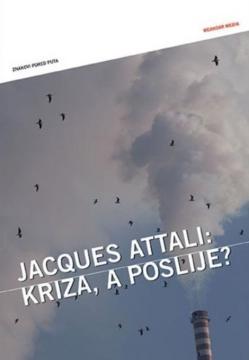
Kriza, a poslije?

Kriza, a poslije?

Jacques Attali

After A Brief History of the Future, Jacques Attali writes a brief history of the present, dissecting the reasons that led to the first global financial crisis, the ways in which it manifests itself, and possible perspectives for the future.

The world seemed to be floating in a golden age: record global economic expansion, an abundance of cheap money, technological leaps, the spread of prosperity to new continents. And then, almost overnight, everything collapsed. The epicenter is America – ordinary citizens who can no longer repay mortgages on houses they bought on unsecured loans. But Attali shows that this is not an accidental accident, but the logical outcome of a system that has been built on unstable foundations for decades.

He leads the reader through a labyrinth: the deregulation of the financial sector that gave banks almost unlimited freedom, the explosion of "subprime" loans transformed into complex derivatives (such as CDOs and CDSs) that no one understood anymore, the greed of investment banks, hedge funds and rating agencies that made huge profits on false security ratings. All this against the background of deep social inequality – the rich were getting richer, and the middle class was artificially maintaining consumption only by borrowing. Globalization, in turn, allowed the virus to spread at lightning speed across the planet.

Attali does not stay only on the diagnosis. He warns that this is more than an economic crisis - it is a threat to democracy itself. If not changed, it may spawn a wave of nationalism, protectionism and even authoritarian regimes. Therefore, in the second part, it offers a way out: strict regulation of financial markets, transparency of dangerous instruments, strengthening of global coordination (as a precursor to some form of world governance), reduction of extreme inequality and transition to a more sustainable, less speculative growth model.

The book is written in a quick, lucid style - Attali does not want to impress experts, but to clarify the "mystery" of the crisis to a wider audience. It is particularly interesting that he himself already warned of the impending collapse in 2006, so his analysis sounds prophetic. Even today, years later, it remains a powerful reminder of how fragile that semblance of prosperity was and how important it is not to repeat the same mistakes.

Original title
La crise, et après ?
Translation
Vanda Mikšić
Editor
Branko Čegec
Illustrations
Stanko Abadžić
Dimensions
21.5 x 13.5 cm
Pages
166
Publisher
MeandarMedia, Zagreb, 2009.
 
Latin alphabet. Paperback.
Language: Croatian.

One copy is available

Condition:Unused
 

Are you interested in another book? You can search the offer using our search engine or browse books by category.

You may also be interested in these titles

Tri svijeta

Tri svijeta

Jacques Attali
24 sata, 1981.
Croatian. Latin alphabet. Hardcover with dust jacket.
6.80
Ova jedina zemlja (Idemo li u katastrofu ili treću revoluciju?)

Ova jedina zemlja (Idemo li u katastrofu ili treću revoluciju?)

Rudi Supek

Supek emphasizes the need for global cooperation and responsibility to ensure the sustainability of our planet.

Naprijed, 1973.
Croatian. Latin alphabet. Paperback.
5.32
Ukrajinski Karpati: Etnogeneza, arheologija, etnologija

Ukrajinski Karpati: Etnogeneza, arheologija, etnologija

The collection is an interdisciplinary bridge between Ukrainian and Croatian science, encouraging comparative research on Slavic migrations. It presents the Carpathians as a "living archipelago" connecting East and West, important for Croatian ethnogenesi

Filozofski fakultet Sveučilišta u Zagrebu, 2014.
Croatian. Latin alphabet. Paperback.
18.34
U obranu naše budućnosti

U obranu naše budućnosti

Freimut Duve

This book aims to be a cultural contribution to an open and free debate, which is necessary after a whole decade filled with crime and war; she wants to be a small step on the way to a democratic Europe.

Durieux, 2001.
Croatian. Latin alphabet. Paperback.
3.98
Što je sociologija?

Što je sociologija?

Norbert Elias

A classic work by one of the most influential sociologists of the 20th century, the founder of "figurative" or "process" sociology. The book is a programmatic manifesto against the then dominant structural-functionalist paradigm (Parsons) and pure positiv

Antibarbarus, 2007.
Croatian. Latin alphabet. Paperback.
8.26
Bolman je bio Bolman

Bolman je bio Bolman

Jovan M. Nedić

Monograph on the Baranja village of Bolman. The book has three main parts: "From the history of the village and the church municipality", "Bolman was Bolman – Vidoja Bijelić's memories" and "Ledari", with a description of Bolman's customs and mentality.

Vlastita naklada, 2012.
Croatian. Latin alphabet. Hardcover.
17.36