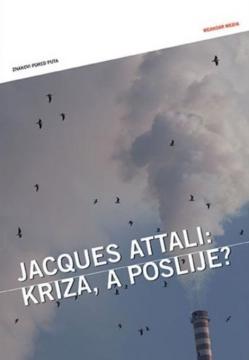
Kriza, a poslije?

Kriza, a poslije?

Jacques Attali

After A Brief History of the Future, Jacques Attali writes a brief history of the present, dissecting the reasons that led to the first global financial crisis, the ways in which it manifests itself, and possible perspectives for the future.

The world seemed to be floating in a golden age: record global economic expansion, an abundance of cheap money, technological leaps, the spread of prosperity to new continents. And then, almost overnight, everything collapsed. The epicenter is America – ordinary citizens who can no longer repay mortgages on houses they bought on unsecured loans. But Attali shows that this is not an accidental accident, but the logical outcome of a system that has been built on unstable foundations for decades.

He leads the reader through a labyrinth: the deregulation of the financial sector that gave banks almost unlimited freedom, the explosion of "subprime" loans transformed into complex derivatives (such as CDOs and CDSs) that no one understood anymore, the greed of investment banks, hedge funds and rating agencies that made huge profits on false security ratings. All this against the background of deep social inequality – the rich were getting richer, and the middle class was artificially maintaining consumption only by borrowing. Globalization, in turn, allowed the virus to spread at lightning speed across the planet.

Attali does not stay only on the diagnosis. He warns that this is more than an economic crisis - it is a threat to democracy itself. If not changed, it may spawn a wave of nationalism, protectionism and even authoritarian regimes. Therefore, in the second part, it offers a way out: strict regulation of financial markets, transparency of dangerous instruments, strengthening of global coordination (as a precursor to some form of world governance), reduction of extreme inequality and transition to a more sustainable, less speculative growth model.

The book is written in a quick, lucid style - Attali does not want to impress experts, but to clarify the "mystery" of the crisis to a wider audience. It is particularly interesting that he himself already warned of the impending collapse in 2006, so his analysis sounds prophetic. Even today, years later, it remains a powerful reminder of how fragile that semblance of prosperity was and how important it is not to repeat the same mistakes.

Original title
La crise, et après ?
Translation
Vanda Mikšić
Editor
Branko Čegec
Illustrations
Stanko Abadžić
Dimensions
21.5 x 13.5 cm
Pages
166
Publisher
MeandarMedia, Zagreb, 2009.
 
Latin alphabet. Paperback.
Language: Croatian.

One copy is available

Condition:Unused
 

Are you interested in another book? You can search the offer using our search engine or browse books by category.

You may also be interested in these titles

Tri svijeta

Tri svijeta

Jacques Attali
24 sata, 1981.
Croatian. Latin alphabet. Hardcover with dust jacket.
6.80 €
Što je sociologija?

Što je sociologija?

Norbert Elias

Klasično djelo jednog od najutjecajnijih sociologa 20. stoljeća, utemeljitelja „figuralne“ ili „procesne“ sociologije. Knjiga je programatski manifest protiv tada dominantne strukturalno-funkcionalističke paradigme (Parsons) i čistog pozitivizma.

Antibarbarus, 2007.
Croatian. Latin alphabet. Paperback.
8.26 €
Kreativne industrije

Kreativne industrije

John Hartley

''Creative Industries'' is a bold collection of essays that charts the tumultuous revolution that is transforming the production, consumption, and understanding of culture in an era of all-connections.

Multimedia Clio, 2007.
Serbian. Latin alphabet. Hardcover.
14.98 €
Istra i njeni razvojni putovi

Istra i njeni razvojni putovi

Juraj Pađen, Stanko Žuljić

The book Istria and its Development Paths from 1973, edited by Juraj Pađen and Stanko Žuljić, is a comprehensive analysis of the economic and social development of Istria in the context of the then Yugoslavia.

Ekonomski institut, 1973.
Croatian. Latin alphabet. Paperback.
7.50 €
S tradicionalnih na nove puteve: Trgovina, obrt, industrija i bankarske ustanove grada Osijeka na prijelazu stoljeća od 1868. do 1918. godine

S tradicionalnih na nove puteve: Trgovina, obrt, industrija i bankarske ustanove grada Osijeka na prijelazu stoljeća od 1868. do 1918. godine

Zlata Živaković-Kerže

The book explores the economic development of Osijek after the Croatian-Hungarian Settlement until the end of World War I. Osijek, as an important center of Slavonia, experienced a significant economic boom thanks to its location on the Drava River and th

Hrvatski institut za povijest, 1999.
Croatian. Latin alphabet. Hardcover.
11.327.92 €
Svaki je kamen da se kuća gradi: Hrvatske poslovice sakupljene u naše dane po književnim i jezikoslovnim djelima nastalima od 12. do 19. stoljeća

Svaki je kamen da se kuća gradi: Hrvatske poslovice sakupljene u naše dane po književnim i jezikoslovnim djelima nastalima od 12. do 19. stoljeća

Josip Kekez

An anthological collection with comments by Josip Kekez, a Croatian folklorist and Slavist. A classic work of Croatian folkloristics from the 1980s.

Izdavački centar Revija, 1986.
Croatian. Latin alphabet. Paperback.
3.86 €