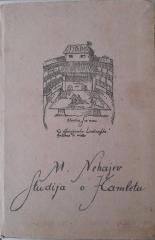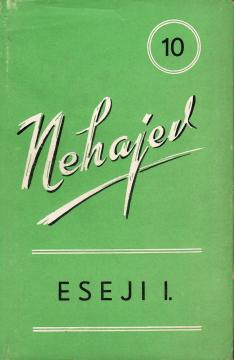
Eseji I.
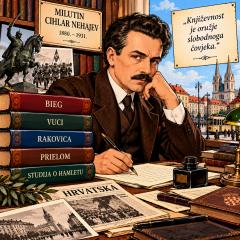
Essays I. (1944) collects the author's significant studies on European classics: Tolstoy, Flaubert, Ibsen, Strindberg, Zola, Dostoevsky, and the essay "On Two Moralities." Profound modern critical-psychological essayism.
Essays I. (1944) brings a selection of the author's most important essays dedicated to great European writers of the 19th and early 20th centuries. In this volume, Nekhayev shows himself to be an extraordinary connoisseur of world literature and a sharp critic who interprets European classics through the prism of modern psychology, philosophy, and his own literary experience.
Nekhayev analyzes Leo Tolstoy as a moral giant and preacher, but also a profound psychologist of human nature. Gustave Flaubert interests him as a master of style and objectivity, the creator of modern realistic prose (Madame Bovary). He pays special attention to Scandinavian playwrights – Henrik Ibsen and August Strindberg – whose plays he sees as mirrors of modern crises of the individual, conflicts of the sexes, social lies, and inner demons. Émile Zola is presented as a representative of naturalism and a scientific approach to literature, while Fyodor Mikhailovich Dostoevsky opens up space for reflections on the Russian soul, suffering, faith and the abyss of the human psyche. In the essay On Two Morals Nekhajev contrasts Christian-evangelical morality and modern, individualistic or Machiavellian morality, exploring the ethical dilemmas of contemporary man.
All essays are imbued with Nekhajev's characteristic style: elegant, precise, psychologically penetrating and subtly ironic. He does not write classical philological studies, but lively, personal essays in which he brings European writers into dialogue with the Croatian context and the problems of modern intelligence – loneliness, weakness of will, conflict between ideals and reality and the search for meaning in a corrupt world. These works complement his own novels and short stories, which often reflect similar motifs.
This 1944 edition is part of the collected works of Milutin Nehajev (1880–1931) and today represents a true rarity, especially in its original cover. The book is a must-have for lovers of comparative literature, modern essays, and in-depth interpretations of European classics from the perspective of Croatian modernists.
One copy is available