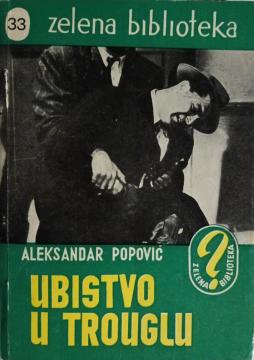
Ubistvo u troglu

Ubistvo u troglu

Aleksandar Popović

"Murder in the Triangle" (1959) follows a mysterious murder in the apartment of a young student in Milan. Inspired by the works of Georges Simenon, the work stands out as a pioneering example of the Serbian crime genre, combining suspense and social criti

The story begins when Milan is found dead, and the police, led by the experienced inspector Petrović, begin an investigation. Suspicion falls on a circle of people connected to Milan: his girlfriend Vera, his friend Zoran, and his neighbor, a mysterious pensioner. Each character carries their own secrets, and the investigation reveals complex relationships, jealousies, and hidden motives.

Popović skillfully builds tension, using the Belgrade setting – narrow streets, smoky taverns, and gray buildings – as a backdrop for a dark atmosphere. Inspector Petrović, methodical and insightful, resembles Simenon’s detectives, exposing lies through conversations and small clues. The novel deals not only with the crime, but also with the psychology of the characters, exploring how greed and passion lead to fatal consequences. The denouement brings an unexpected twist, revealing a murderer whose motive lies in deeply repressed emotions.

Popović's style is realistic, with an emphasis on dialogue and details of everyday life, which makes the novel a convincing depiction of Belgrade in the 1950s.

Editor
Živan Mitrović
Dimensions
17 x 12.5 cm
Pages
246
Publisher
Kosmos, Beograd, 1959.
 
Latin alphabet. Paperback.
Language: Serbian.

One copy is available

Condition:Used, very good condition
Damages or inconvenience notice:
  • Traces of patina
 

Are you interested in another book? You can search the offer using our search engine or browse books by category.

You may also be interested in these titles

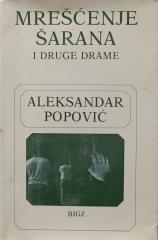
Mrešćenje šarana i druge drame

Mrešćenje šarana i druge drame

Aleksandar Popović
BIGZ, 1986.
Croatian. Latin alphabet. Paperback with dust jacket.
4.99
Made in U.S.A.

Made in U.S.A.

Goran Tribuson

Imagine Zagreb in the 1980s, where behind the gray facades of apartment buildings lies a dream world of the far West – Hollywood, freedom and endless possibilities. Tribuson, a master of Croatian prose, here combines genres into one fluid story that bites

Znanje, 1986.
Croatian. Latin alphabet. Hardcover with dust jacket.
5.72
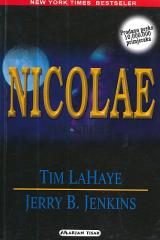
Nicolae – Uspon Antikrista

Nicolae – Uspon Antikrista

Tim Lahaye, Jerry B. Jenkins

In Nicolae, the most explosive of the three books so far, the end of the first quarter of the seven-year martyrdom is approaching when, as the prophecy says, the "wrath of the Lamb" will descend on the earth.

Marjan tisak, 2003.
Croatian. Latin alphabet. Paperback.
5.62
Kod bijelog konja

Kod bijelog konja

Agatha Christie

In the novel At the White Horse (1961), Christie combines the supernatural and the rational in a story of mysterious deaths and an organization that offers "services" of elimination, inspired by Dennis Wheatley, with a focus on inheritance and the ethics

Globus, 1984.
Croatian. Latin alphabet. Hardcover with dust jacket.
8.34
Topaz

Topaz

Leon Uris

Topaz is a Cold War suspense novel by Leon Uris, published in 1967 by McGraw-Hill. The novel spent one week atop The New York Times Best Seller List, and was Uris's first New York Times number-one bestseller since Exodus in 1959.

Otokar Keršovani, 1970.
Croatian. Latin alphabet. Hardcover with dust jacket.
8.68
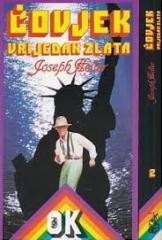
Čovjek vrijedan zlata

Čovjek vrijedan zlata

Joseph Heller

Bruce Gold, a literature professor and Jewish man from Brooklyn, is offered a chance to become a high-ranking official in Washington. While trying to write a book about the Jewish experience, he becomes entangled in the absurd world of politics, confronti

Otokar Keršovani, 1987.
Croatian. Latin alphabet. Paperback.
The book consists of two volumes
6.32