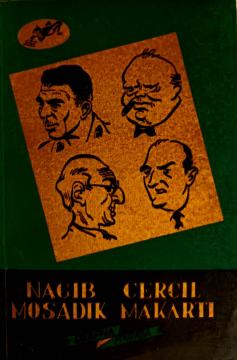
Nagib Čerčil, Mosadik Makarti
Two copies are available
Copy number 1
- Slight damage to the cover
- Signature of previous owner
Copy number 2
- Traces of patina
- Signature of previous owner

Two copies are available
Are you interested in another book? You can search the offer using our search engine or browse books by category.
Amir Duranović's book reconstructs in detail the dramatic year 1966 and the Fourth (Brion) Session of the Central Committee of the Communist Party of Yugoslavia (July 1–2, 1966), at which Aleksandar Ranković, the long-time head of the UDB and vice preside
The collection of columns, Put u Balkanija, critically reflects on Croatian reality at the turn of the millennium. Through satire and philosophical reflection, the author dissects social problems, warning of the dangers of "Balkanization" and calling for
Dara Janeković, a Croatian journalist, publicist and traveler, known for her in-depth reports on the Middle East (When the Sea Boils, Encounters with History), provides a poignant testimony about the Israeli-Palestinian conflict in Joshua's Heirs.
Boris Maruna, a poet and essayist, has carried the burden of a history that has been silenced and entrusted to myth since his early youth. He carried this burden in his poems, but also in his essayistic prose, which is brought together for the first time
The book by Raif Dizdarević, one of the last living actors of Yugoslav diplomacy, presents his reconstruction of the most fateful moment of post-war Yugoslavia – the split with Stalin and the Informburo in 1948–1953.
In the book, economist Jeffrey Sachs presents an optimistic plan for eliminating extreme poverty by 2025. He argues that this is feasible with political will, because world wealth is growing, and poverty is not fate, but the result of inefficient systems.