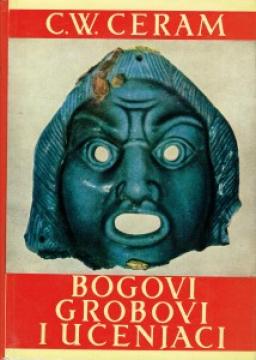
Bogovi, grobovi i učenjaci: roman o arheologiji

Bogovi, grobovi i učenjaci: roman o arheologiji

C. W. Ceram

The book is an attempt to bring the scientific facts related to the archaeological research of the oldest civilizations closer to the reader and make them interesting. Written fluently, the book really reads like the most suspenseful novel.

The book Gods, graves, scientists was written without scientific ambitions. It represents an attempt to make one science an object of observation, to make the work of researchers and scientists visible, above all its inner tension, dramatic knot, their human meaning. At the same time, one should not be afraid of straying, and not even of personal reflections. This is how a book was created that a scientist must call "unscientific". Apology for that is my intention. I saw that this abundant science, which combines adventure and cabinet diligence, romantic endeavors and personal spiritual satisfaction, is stored in published professional writings. Regardless of the value of these scientific publications, they were not written to be "read". It is significant that so far there have been only three or four attempts to record past research as interesting adventures. And there are hardly any more exciting adventures than that, if one considers that adventure is always a mixture of spirit and action.

Original title
Götter, Gräber und Gelehrte
Translation
Stanislav Šimić
Dimensions
22 x 15 cm
Pages
420
Publisher
Matica hrvatska, Zagreb, 1955.
 
Latin alphabet. Hardcover with dust jacket.
Language: Croatian.

One copy is available

Condition:Used, very good condition
Damages or inconvenience notice:
  • Slight damage to the dust jacket
Discounted price: 12.658.86
30% discount is valid until 8/31/26 11:59 pm
 

Are you interested in another book? You can search the offer using our search engine or browse books by category.

You may also be interested in these titles

Kontraznanje: Kako smo podlegli teorijama zavjere, nadriliječništvu, pseudoznanosti i kvazipovijesti

Kontraznanje: Kako smo podlegli teorijama zavjere, nadriliječništvu, pseudoznanosti i kvazipovijesti

Damian Thompson

A book by British journalist Damian Thompson defines counterknowledge as false information packaged to appear as fact, warning of a dangerous trend of suppressing empirical science in contemporary society.

Algoritam, 2009.
Croatian. Latin alphabet. Paperback.
6.44
Iz prirode: popularno-naučna razmatranja

Iz prirode: popularno-naučna razmatranja

Feliks Barušić

The book by Feliks Barušić, a Croatian writer, pedagogue and science popularizer from Osijek, is a collection of popular science essays about natural phenomena, science and life intended for a wider audience.

Vlastita naklada, 1899.
Croatian. Latin alphabet. Paperback.
8.56
Posljednji dani ljudi

Posljednji dani ljudi

Camille Flammarion

The second part of Flammarion's popular science work The Doom of the World (1894.). A speculative account of life on Earth in ten million years and the gradual end of humanity. Popular science with elements of science fiction.

Hrvatsko prirodoslovno društvo, 1920.
Croatian. Latin alphabet. Paperback.
12.34
Energija djetetove prošlosti

Energija djetetove prošlosti

Nera Kutlača

The book explores themes of childhood trauma, injustice, personal growth, and self-discovery through life's challenges, using retrospective narratives to illustrate key life lessons.

Redak d.o.o., 2024.
Croatian. Latin alphabet. Paperback.
9.98
Umberto Eco i nogomet

Umberto Eco i nogomet

Peter Pericles Trifonas

Trifonas analyzes how Umberto Eco dismantles football as a mass spectacle through semiotics. The book exposes how sport becomes a powerful instrument of social control and political manipulation.

Jesenski i Turk, 2002.
Croatian. Latin alphabet. Paperback.
3.46
Uvjeti umnog gospodarenja: Pokušaj popularizacije agrikulturne kemije

Uvjeti umnog gospodarenja: Pokušaj popularizacije agrikulturne kemije

Ilija Bošnjak

Ilija Bošnjak's first book, "Conditions of Intelligent Management", an attempt to popularize agricultural chemistry for farmers and students. The book was edited and published by Milan Metelka.

Vlastita naklada, 1906.
Croatian. Latin alphabet. Paperback.
23.56