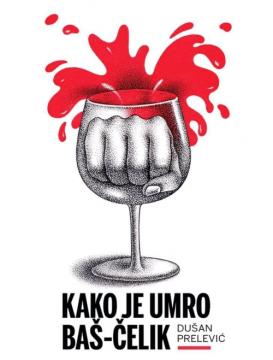
Kako je umro Baš Čelik

Kako je umro Baš Čelik

Dušan Prelević
Graphics design
Jugoslav Vlahović
Dimensions
22 x 11.5 cm
Pages
119
Publisher
Književne novine, Beograd, 1987.
 
Distribution: 5,000 copies
 
Latin alphabet. Paperback.
Language: Serbian.

No copies available

The last copy was sold recently.
 

Are you interested in another book? You can search the offer using our search engine or browse books by category.

You may also be interested in these titles

Vidjet ćeš kad odrasteš

Vidjet ćeš kad odrasteš

Luca Kozina

You'll See When You Grow Up by Luce Kozine is a striking collection of stories that, from a child's perspective, speaks about the traumas of growing up, the hypocrisy of adults, and the hope that can still save us.

Fraktura, 2024.
Croatian. Latin alphabet. Hardcover with dust jacket.
14.54
Drugi Ajnštajn

Drugi Ajnštajn

Mari Benedikt

"A novel that reveals to you the secrets of Mileva's heart, her thoughts and the passionate spirit of a scientist - a woman fighting for her place in the world of science ruled by men."

Laguna, 2019.
Serbian. Latin alphabet. Paperback.
5.98
Oboje bosonogi

Oboje bosonogi

Lidija Scheuermann Hodak

It is about the world of our Slavonian wastelands, a microspace in which all 60 stories take place. Numerous characters are woven into these stories with their own destinies.

Matica hrvatska, 2024.
Croatian. Latin alphabet. Paperback.
10.98
Mirna ulica, drvored

Mirna ulica, drvored

Nada Gašić

A story from a Zagreb neighborhood patiently, concentratedly, and intelligently unfolds before the reader's eyes.

Algoritam, 2007.
Croatian. Latin alphabet. Hardcover.
7.985.59
Koncert za tequilu i apaurin

Koncert za tequilu i apaurin

Edo Popović

A short novel by Edo Popović, one of the most important Croatian prose writers of the 1990s and 2000s. The book is part of Popović's "Zagreb Cycle" – a critique of transition without pathos, but through absurdity and grotesqueness.

Meandar, 2003.
Croatian. Latin alphabet. Paperback.
3.26
Život je negdje drugdje

Život je negdje drugdje

Milan Kundera

Jaromil, a young poet raised by a possessive mother, seeks a "real life" in poetry and revolution. His lyrical youth, love, and idealism lead him into conformity and betrayal of intimate relationships – he dies young and unfulfilled.

Znanje, 1979.
Croatian. Latin alphabet. Hardcover with dust jacket.
4.86