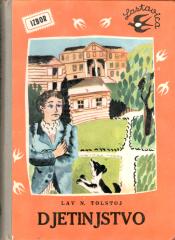
Djela #17: U svijetu

Djela #17: U svijetu

Maksim Gorki

"In the World" is the second part of Maxim Gorky's autobiographical trilogy, published in 1916. The trilogy includes the works "Childhood", "In the World", and "My Universities", providing insight into the author's formative years.

In this central part, Gorky describes his teenage years after escaping from a dysfunctional family. He faces the challenges of independent living, working various jobs such as a shop assistant, a ship's worker, and a printer's apprentice. Through these experiences, he meets various people from the lower strata of society, which shapes his social consciousness and empathy for the oppressed.

Gorky realistically depicts the harshness of life as a young man left to his own devices in Tsarist Russia. At the same time, he emphasizes the importance of self-education and personal development despite adverse circumstances. This part of the trilogy emphasizes the formation of Gorky's political beliefs and literary sensibilities, which would later characterize his work.

"In the World" is not only a personal story, but also a testimony to the social conditions of the time, giving readers an authentic insight into the lives of ordinary people and the challenges they faced.

Original title
В людях
Graphics design
E. Stepančić
Dimensions
20 x 14 cm
Pages
327
Publisher
Kultura, Beograd-Zagreb, 1949.
 
Distribution: 10,000 copies
 
Latin alphabet. Hardcover.
Language: Croatian.

Multiple copies are available

Copy number 1

Condition:Used, excellent condition

Copy number 2

Condition:Used, excellent condition

Copy number 3

Condition:Used, excellent condition
 

Are you interested in another book? You can search the offer using our search engine or browse books by category.

You may also be interested in these titles

Moji univerziteti

Moji univerziteti

Maksim Gorki
Rad, 1959.
Serbian. Latin alphabet. Paperback.
0.99
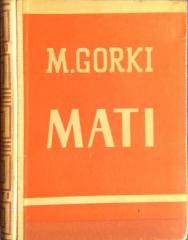
Mati

Mati

Maksim Gorki

Maxim Gorky's novel "Mother" was published in 1906 and is one of the key works of Russian social realism. The work depicts the awakening of the working class in Russia through characters and events that emphasize social injustices and the need for revolut

Glas rada, 1950.
Croatian. Latin alphabet. Hardcover with dust jacket.
4.36
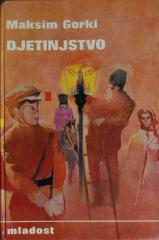
Djetinjstvo

Djetinjstvo

Maksim Gorki
Mladost, 1982.
Croatian. Latin alphabet. Hardcover.
2.99 - 3.98
Moskva – Petuški

Moskva – Petuški

Venjedikt Jerofejev

Venedikt Yerofeyev's postmodern prose poem is today considered a classic of new Russian literature. It is compared to Gogol and Kharms for its poetics of absurdity, satire, and metaphysical depth.

LOM, 217.
Serbian. Cyrillic alphabet. Paperback.
11.24
O čemu ne govorimo

O čemu ne govorimo

Slavenka Drakulić

Can you face the taboos of modern society? Old age, illness, weakness. Slavenka Drakulić bravely enters into topics we are reluctant to talk about.

Fraktura, 2024.
Croatian. Latin alphabet. Hardcover with dust jacket.
14.62
Pažnja

Pažnja

Alberto Moravia

Francesco Merighi returns to Rome after 9 years abroad. In order to write an "authentic" novel, he keeps a diary of his life with his wife and their daughter Babe. He obsessively analyzes lies in relationships, the temptation of

Otokar Keršovani, 1966.
Croatian. Latin alphabet. Hardcover.
3.96