Canterburyjske priče

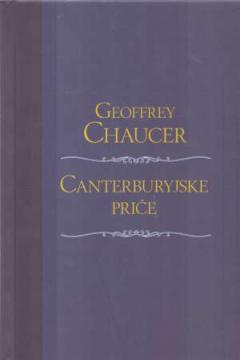
Canterburyjske priče

Geoffrey Chaucer

A collection of stories by Geoffrey Chaucer, mostly in verse, written in Middle English between 1387 and 1400. It is one of the foundational works of English literature. It was partly modeled on Giovanni Boccaccio's Decameron.

The collection is framed by the story of 30 pilgrims who travel from the London area to Canterbury in the province of Kent to pay their respects to the grave of Thomas Becket. Pilgrims are representatives of different social classes, professions and personalities. Before leaving, they gather at the Tabard Inn and agree to have a story-telling competition on the way to Canterbury and back. Chaucer planned to write about a hundred stories, two for each pilgrim on the way out and on the way back. By the end of his life, he wrote 24 of them, of which 22 were in verse (Jampa ten), and two were in prose. The stories vary in genre from chivalric romances, folk tales, saints' legends and fables to hymns, allegories and even alchemical calculations. Themes and stories are taken from the Decameron, French literature and local legends. They are imbued with irony, humor, and sometimes satire. They are characterized by the simplicity and ease of presentation and the use of proverbs, wise sayings and other features of the vernacular of the time.

Original title
The Canerbury tales
Translation
Luko Paljetak
Dimensions
20 x 13 cm
Pages
671
Publisher
Globus, Zagreb, 2004.
 
Latin alphabet. Hardcover.
Language: Croatian.
ISBN
9-53-716055-6

Two copies are available

Copy number 1

Condition:Used, very good condition
Damages or inconvenience notice:
  • Yellowed pages

Copy number 2

Condition:Used, excellent condition
 

Are you interested in another book? You can search the offer using our search engine or browse books by category.

You may also be interested in these titles

Kraljev gambit

Kraljev gambit

Branka Slijepčević
Znanje, 1988.
Croatian. Latin alphabet. Hardcover with dust jacket.
4.22
Quo Vadis?

Quo Vadis?

Henryk Sienkiewicz

The novel Quo Vadis is a historical saga set in Rome during the reign of Emperor Nero. Written with epochal breadth, the work explores the conflict between early Christianity and decadent Roman society, with a love story at its center.

Minerva, 1964.
Serbian. Latin alphabet. Hardcover.
2.98
Demonja

Demonja

Milan Nožinić

This book tells the legend of Nikola Demonja, a prominent partisan fighter and commander, hero of Banija and Slavonia, and of a whole galaxy of his comrades, as well as the fates of the people, women, and children we will encounter on Demonja's warrior

Novo pokoljenje, 1950.
Croatian. Latin alphabet. Paperback.
4.96
Svrgnuti princ

Svrgnuti princ

Miguel Delibes
Nolit, 1989.
Serbian. Latin alphabet. Hardcover.
5.994.49 - 7.99
U traganju za izgubljenim vremenom 11: Bjegunica

U traganju za izgubljenim vremenom 11: Bjegunica

Marcel Proust

In Bjegunica, the protagonist learns that Albertine died in an accident and he recreates their meetings and life in his spirit.

Zora, 1972.
Croatian. Latin alphabet. Hardcover with dust jacket.
5.00 - 5.62
Kurlani

Kurlani

Mirko Božić

The first part of the Kurlan trilogy, a novel divided into three parts: "Carnival", "Procession" and "Legend". The action takes place in the fictional village of Kurlani near Sinj (Cetinska krajina, 1930s), between the feuding brothers Gornji and Donji Ku

Nakladni zavod Matice hrvatske, 1989.
Croatian. Latin alphabet. Hardcover.
5.32