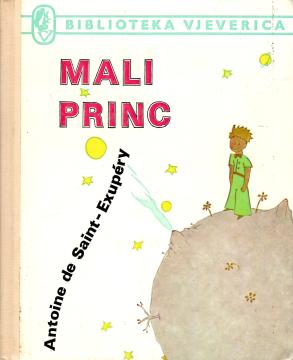
Mali princ

Mali princ

Antoine de Saint-Exupéry

The Little Prince was published for the first time in Paris in 1943, and since then it has become a cult book among both children and adults. Through the story of the little prince, Exupéry spoke simple but important truths about the true values ​​of huma

The main narrator is a pilot who, after a plane crash in the desert, meets an unusual boy – the Little Prince – who comes from the distant asteroid B-612.

Through conversations with the pilot, the Little Prince tells of his journey across various planets, where he meets strange adults: a king, a vain man, a drunkard, a businessman, a lighthouse keeper and a geographer. Each of them symbolizes a certain human weakness or the meaninglessness of modern society, which the boy – with his childish gaze – sees through and rejects.

The most important part of the story concerns his relationship with a single rose on his own planet. Although capricious and demanding, the rose becomes dear and irreplaceable to him. It is through this relationship that the Little Prince discovers that true love requires commitment and responsibility – "what is essential is invisible to the eye, the heart sees best."

The work is imbued with warmth, tenderness and a philosophical tone. Written simply, yet with a profound meaning revealed through symbolism and ambiguity, "The Little Prince" is a universal story that speaks equally powerfully to children and adults, urging them not to forget what it means to be human – compassionate, honest, and open-hearted.

Original title
Le petit prince
Translation
Mia Pervan Plavec
Illustrations
Antoine de Saint-Exupéry
Dimensions
21 x 17 cm
Pages
93
Publisher
Mladost, Zagreb, 1989.
 
Latin alphabet. Hardcover.
Language: Croatian.
ISBN
8-60-500368-5

Two copies are available

Copy number 1

Condition:Used, excellent condition

Copy number 2

Condition:Used, excellent condition
 

Are you interested in another book? You can search the offer using our search engine or browse books by category.

You may also be interested in these titles

Mali princ

Mali princ

Antoine de Saint-Exupéry
Mozaik knjiga, 2004.
Croatian. Latin alphabet. Paperback.
5.96 - 5.98
Zemlja ljudi

Zemlja ljudi

Antoine de Saint-Exupéry
Svjetlost, 1960.
Croatian. Latin alphabet. Paperback.
3.98
Evgenija Grande / Muzej starina

Evgenija Grande / Muzej starina

Honore de Balzac

In his novels Eugenie Grandet (1833) and The Museum of Antiquities (1837), Balzac explores universal themes of greed, human passions, sacrifice, and moral dilemmas, placing them in different social contexts of 19th-century French society.

Svjetlost, 1963.
Croatian. Latin alphabet. Hardcover.
3.48
Evgenija Grande

Evgenija Grande

Honore de Balzac

"Eugénie Grandet" (1833), part of Balzac's Human Comedy, is a realistic novel that explores greed, family relationships, and the sacrifices of love in provincial French society.

Veselin Masleša, 1989.
Croatian. Latin alphabet. Hardcover.
4.98
Kiše

Kiše

Saint-John Perse
Bagdala, 1962.
Serbian. Cyrillic alphabet. Paperback.
4.28
Četrdeset pet vitezova, sv. 1-2

Četrdeset pet vitezova, sv. 1-2

Alexandre Dumas

Alexandre Dumas – The Forty-Five Knights, published in 1966, is part of a grand trilogy about the political and religious turmoil in France during the late 16th century.

Epoha, 1966.
Croatian. Latin alphabet. Hardcover with dust jacket.
The book consists of two volumes
9.48