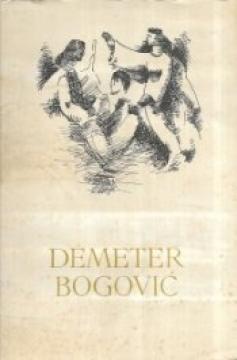
PSHK # 31: Članci, Grobničko polje, Teuta / Članci, pjesme, Šilo za ognjilo, Matija Gubec
This volume brings together works by Dimitrije Demeter and Mirko Bogović, representatives of the Croatian National Revival and Romanticism. It includes their articles, poetry, and the historical dramas *Teuta* and *Matija Gubec*.
Volume 31 of the Five Centuries of Croatian Literature series (published in 1968) brings together the literary works of Dimitrije Demeter and Mirko Bogović, two authors associated with the Croatian National Revival and 19th-century literature. The volume was edited by Jakša Ravlić and spans 469 pages.
The first section is dedicated to Dimitrije Demeter. Following an introductory overview of his life and work, as well as a bibliography, the volume presents the essays "Thoughts on the Illyrian Literary Language" and "On the Founding of the National Theatre," alongside "Our National Language" and "Native Voices" (Domorodni glasi). These texts demonstrate Demeter’s interest in the development of the Croatian literary language, national culture, and the creation of a modern Croatian theatre.
The core of Demeter’s body of work consists of the pieces Grobničko polje (Grobnik Field) and Teuta. Grobničko polje is a historical-Romantic narrative poem linked to the legend of the victory over the Mongols at Grobnik Field, while Teuta is a historical drama set in antiquity. Through these historical themes, Demeter explores issues of freedom, national consciousness, heroism, and a sense of belonging to the community.
The second section of the book is dedicated to Mirko Bogović and features his essays and poems—including Native Voices—as well as the narrative work Šilo za ognjilo and the historical drama Matija Gubec.
A special place is held by Matija Gubec, a drama concerning the Peasant Revolt of 1573. Bogović uses historical events to explore themes of social injustice, freedom, resistance, and the plight of the oppressed. Peasants appear in the drama as the driving force of the action, a key element of its social themes.
The volume thus interweaves language, the national idea, history, theater, poetry, and social issues, offering an overview of a significant segment of Croatian literature from the eras of the National Revival and Romanticism.
Es werden zwei Exemplare angeboten
Kopiennummer 1
Kopiennummer 2
- Stains on cover
- Traces of patina
- The cover is missing