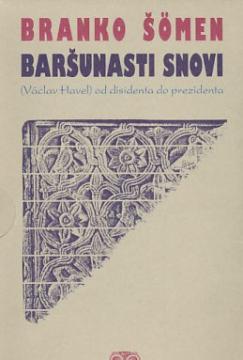
Baršunasti snovi: Vaclav Havel od disidenta do prezidenta

Baršunasti snovi: Vaclav Havel od disidenta do prezidenta

Branko Šömen
Translation
Boro Jurković
Dimensions
20 x 14 cm
Pages
236
Publisher
Hiram, Zagreb, 1992.
 
Distribution: 1,000 copies
 
Latin alphabet. Paperback.
Language: Croatian.

No copies available

The last copy was sold recently.

 

Are you interested in another book? You can search the offer using our search engine or browse books by category.

You may also be interested in these titles

I drugi su pjevali o ratu: Odjeci raspada Jugoslavije u engleskoj i američkoj književnosti

I drugi su pjevali o ratu: Odjeci raspada Jugoslavije u engleskoj i američkoj književnosti

Muharem Bazdulj

Muharem Bazdulj u ovoj knjizi eseja analizira kako je raspad Jugoslavije i ratovi 1990-ih odjeknuli u anglosaksonskoj književnosti – od predratnih stereotipa do ratnih i poslijeratnih prikaza.

Biblioteka XX vek, 2013.
Croatian. Latin alphabet. Paperback.
8.24
Kratka povijest ljudske rase

Kratka povijest ljudske rase

Michael Cook

Michael A. Cook, Princeton professor of Islamic history, provides an overview of human history from the Neolithic to the fall of the Twin Towers in 2001 in this witty and intelligent synthesis, asking the key question: why did everything happen exactly th

Profil Knjiga, 2009.
Croatian. Latin alphabet. Paperback.
16.2812.21
The Welfare State We're in

The Welfare State We're in

James Bartholomew
Politico's Publishing, 2004.
English. Latin alphabet. Hardcover with dust jacket.
15.2212.18
Politički zapisi

Politički zapisi

Ivan Ribar
Prosveta, 1948.
Croatian. Latin alphabet. Paperback.
6.26
RAF: Frakcija Crvene Armije 1970-1998

RAF: Frakcija Crvene Armije 1970-1998

Pavle Kalinić

Pavle Kalinić's book is an authoritative account of... the period... in which the German Red Army Faction was created and operated.

Profil International, 2002.
Croatian. Latin alphabet. Paperback.
5.84
Što je Opus Dei? Priče o Bogu, krvi, novcu i vjeri

Što je Opus Dei? Priče o Bogu, krvi, novcu i vjeri

Noam Friedlander

The Catholic movement Opus Dei, founded in 1928 in Spain as a small devout group, is today one of the most influential and richest church organizations in the world – with millions of members, a headquarters in New York worth billions, and branches across

Naklada Ljevak, 2005.
Croatian. Latin alphabet. Hardcover.
13.26