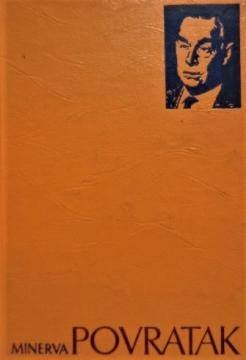

Povratak

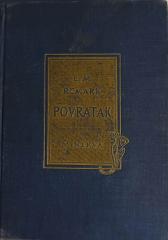
Povratak

Erich Maria Remarque

The novel follows soldiers who return to a devastated and politically unstable Germany after the First World War. Faced with trauma and the impossibility of fitting into civilian life, they realize that the war has remained in them forever.

As a sequel to the famous novel All Quiet on the Western Front, The Return explores the fate of the same group of young men whose youth was destroyed by the trench massacre. Here, Erich Maria Remarque does not celebrate the victors of the war, but dissects the painful reality of people whose future was taken away. Returning home does not bring peace, but the bitter realization that the soldiers have become strangers in their own country.

The main character Ernst Birkholz, together with his comrades such as Adolf Betke, Ludwig Brenk and Jutta, tries to find their place in a society steeped in hypocrisy, poverty, hunger and political unrest. Civilian institutions, schools and families seem to them like sterile backdrops that do not understand the horrors they have been through. The author masterfully depicts how the authorities who sent them to their deaths continue to have the upper hand, while the returnees struggle with PTSD, existential anxiety and shattered illusions.

The novel delves deeply into the psychology of the individual. Some soldiers turn to cynicism, others to political extremism that already foreshadows the coming fascism, while a few try to build fragile human bonds. The characters are permanently marked by the death of a friend, and many experience a final breakdown because they cannot adapt to the rhythm of peacetime.

Remarque's style is realistic, uncompromising and filled with deep humanism. Due to its strong anti-war charge and open pointing to the rot of society, the novel was later banned and burned by the Nazis. The Return remains a timeless testament to a lost generation and the lasting effects of every conflict on the human psyche.

Original title
Der Weg Zurück
Translation
Kaćuša Avakumović-Maletin
Editor
Milivoje Marković
Dimensions
20 x 15 cm
Pages
282
Publisher
Minerva, Subotica, 1978.
 
Latin alphabet. Hardcover.
Language: Serbian.

Two copies are available

Copy number 1

Condition:Used, excellent condition

Copy number 2

Condition:Used, very good condition
Damages or inconvenience notice:
  • Slight damage to the cover
 

Are you interested in another book? You can search the offer using our search engine or browse books by category.

You may also be interested in these titles

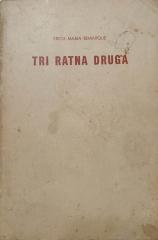
Tri ratna druga

Tri ratna druga

Erich Maria Remarque

Three World War I comrades—Robbie, Otto, and Gottfried—try to survive in Weimar Germany in 1928. Amid economic crisis, poverty, and political violence, their friendship is their only refuge.

Minerva, 1953.
Serbian. Latin alphabet. Paperback.
1.99
Povratak

Povratak

Erich Maria Remarque
Minerva, 1955.
Croatian. Latin alphabet. Hardcover.
1.62 - 1.98
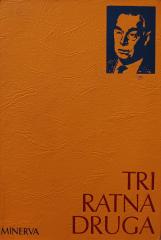
Tri ratna druga

Tri ratna druga

Erich Maria Remarque

Three World War I comrades—Robbie, Otto, and Gottfried—try to survive in Weimar Germany in 1928. Amid economic crisis, poverty, and political violence, their friendship is their only refuge.

Minerva, 1978.
Serbian. Latin alphabet. Hardcover.
3.99 - 8.98
Tajanstveni stranci

Tajanstveni stranci

Wilhelm Hauff

The work is permeated with a mysterious atmosphere, tension, and elements of romanticism.

Naprijed, 1964.
Croatian. Latin alphabet. Paperback.
3.00
Pero i Pava

Pero i Pava

Paula Preradović

A historical novel about the great love of Croatian poet Petar Preradović and his first wife Pavica (Pava) from a Dalmatian noble family. A touching story of love, marriage, war and tragic fate in the turbulent 19th century.

Nakladni zavod Ante Velzek, 1940.
Croatian. Latin alphabet. Hardcover with dust jacket.
3.26 - 11.42
Roman jednoga kapelana

Roman jednoga kapelana

Hubert Kraft Strachwitz

A novel from the era of the Kulturkampf in Germany, which depicts the suffering and resistance of a Catholic chaplain in conflict with the Bismarckian persecution of the Church, religious struggle and fidelity to ideals.

Hrvatsko književno društvo Sv. Jeronima, 1928.
Croatian. Latin alphabet. Hardcover.
11.36