Vasiona, život, razum
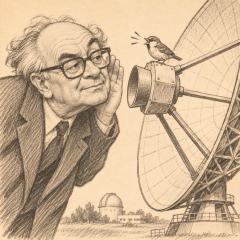
How do planets form, where might life arise, and how would we recognise a signal from another civilisation? Astrophysicist Iosif Shklovsky explores what astronomy can tell us about these questions.
If a radio telescope picked up an unusual signal from space, how could we tell whether an intelligent being had sent it? In Vasiona, život, razum (Universe, Life, Intelligence), Soviet astrophysicist Iosif Shklovsky begins with the formation of stars and planets. He then asks what conditions might allow life to arise on a planet and how we might recognise such a world from afar. Earth is his starting point for comparison, the one place where we can study how life actually developed.
Part of the book is devoted to the search for extraterrestrial civilisations. Shklovsky considers what we might learn by listening for radio signals and how robotic probes could contribute to the search. Before considering contact, there is a more basic question to answer. How would we distinguish a trace of technology from a natural phenomenon? Even if a civilisation elsewhere could send a message, distance and the time a signal takes to travel would shape what we could hear from it.
The book captures the excitement of the early Space Age, when new instruments made it possible to approach the old question of inhabited worlds as a subject for research. This Serbian edition includes commentary by physicist Vladan Čelebonović.
One copy is available