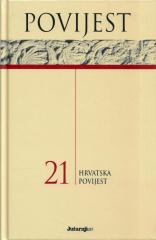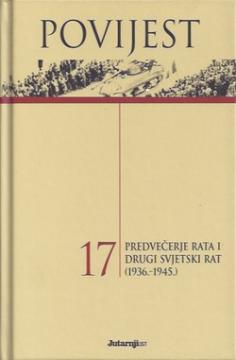
Povijest #17: Predvečerje rata i drugi svjetski rat

Povijest #17: Predvečerje rata i drugi svjetski rat

The seventeenth volume of the World History series covers the period from 1936 to 1945, focusing on the eve and course of World War II. The book provides a comprehensive account of the war's causes, course, and consequences, including the beginning of the

The global economic crisis of 1929 deepens political instability, fueling the rise of totalitarian regimes. Nazi Germany under Hitler, fascist Italy and militaristic Japan spread aggression. The Munich Pact (1938) and the policy of appeasement did not prevent the German annexation of Austria and the Sudetenland. The attack on Poland in 1939 starts the war.

The Second World War (1939–1945) was marked by global conflicts, the Holocaust and mass destruction. The Allies (USA, USSR, Britain) oppose the Axis Powers. Key battles, such as Stalingrad and Normandy, change the course of the war, which ends with the capitulation of Germany and the atomic bombing of Japan (1945). War brings millions of victims and changes the world order.

Culturally, the period is marked by propaganda art, while science advances through the development of nuclear weapons. In the Croatian context, the creation of the Independent State of Croatia (1941), collaboration with the Axis, the partisan movement led by Tito, and the liberation of Yugoslavia stand out.

Translation
Ana Badurina
Editor
Enrico Cravetto, Ivo Goldstein
Dimensions
21 x 14 cm
Pages
623
Publisher
Europapress holding, Zagreb, 2008.
 
Latin alphabet. Hardcover.
Language: Croatian.
ISBN
978-9-53300-054-1

One copy is available

Condition:Unused
 

Are you interested in another book? You can search the offer using our search engine or browse books by category.

You may also be interested in these titles

Buharinove posljednje godine

Buharinove posljednje godine

Roj Medvedev

In his book Bukharin's Last Years, Roy Medvedev reconstructs the tragic fate of Nikolai Bukharin, one of the most prominent Bolshevik intellectuals and political leaders, who became a victim of Stalin's purges.

Globus, 1980.
Croatian. Latin alphabet. Hardcover with dust jacket.
4.32 - 5.56
Zagreb tisuću devetsto četrdeset prve

Zagreb tisuću devetsto četrdeset prve

Ivan Šibl

"Zagreb one thousand nine hundred and forty-first" is not only a historical overview of events, but at the same time it is also a book in which the author vividly and directly outlined dozens of portraits. A book that is at the same time a historiographic

Naprijed, 1967.
Croatian. Latin alphabet. Hardcover with dust jacket.
7.98
Ruska kapitalistička revolucija

Ruska kapitalistička revolucija

Anders Åslund
Dnevnik d.o.o., 2010.
Croatian. Latin alphabet. Paperback.
23.9917.99
Svjedok povijesti

Svjedok povijesti

Charles E. Bohlen
Globus, 1973.
Croatian. Latin alphabet. Hardcover with dust jacket.
7.32 - 8.65
Mogućnosti razvoja industrije osječke regije

Mogućnosti razvoja industrije osječke regije

Petar Anić
NIP Štampa, 1970.
Croatian. Latin alphabet. Paperback.
9.986.99
Snažan eho brionski: Odjeci Brionskog plenuma u Bosni i Hercegovini 1966. godine

Snažan eho brionski: Odjeci Brionskog plenuma u Bosni i Hercegovini 1966. godine

Amir Duranović

Amir Duranović's book reconstructs in detail the dramatic year 1966 and the Fourth (Brion) Session of the Central Committee of the Communist Party of Yugoslavia (July 1–2, 1966), at which Aleksandar Ranković, the long-time head of the UDB and vice preside

Udruženje za modernu historiju (UMHIS), 2017.
Croatian. Latin alphabet. Paperback.
9.54