Sigmund Freud
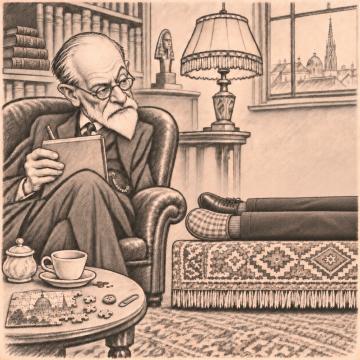
Sigmund Freud would probably notice if you turned up in two different shoes. If you said you’d simply been in a hurry, he might ask what was so important that you forgot to look down. In The Psychopathology of Everyday Life (Zur Psychopathologie des Alltagslebens, first published in 1901 and issued as a book in 1904), small incidents like these get the floor. A forgotten name, a slip of the tongue or a misplaced object becomes a reason to ask how well we know our own intentions.
Freud (Freiberg in Moravia, now Příbor, 1856 – London, 1939) was a doctor and the founder of psychoanalysis. He grew up in Vienna, studied medicine and worked as a neurologist. He went on to develop a method in which patients were asked to say whatever came to mind, even when it seemed trivial or embarrassing. He saw patients at Berggasse 19 in Vienna until 1938. After Nazi Germany annexed Austria, he fled to London with his family. He spent the last year of his life there, and his couch is now on display at the Freud Museum.
In The Interpretation of Dreams (Die Traumdeutung, dated 1900 on the title page), Freud starts with what we remember on waking and follows the associations that gather around the details of a dream. In Three Essays on the Theory of Sexuality (Drei Abhandlungen zur Sexualtheorie, 1905), he considers how sexuality develops from childhood onwards, unsettling his contemporaries’ ideas about childhood innocence. In Civilization and Its Discontents (Das Unbehagen in der Kultur, 1930), he asks how far life in society protects us and how many of our wishes we give up in return.
Freud’s interpretations were disputed in his own lifetime. You can still read his books for the way he builds an argument. He starts with something most people would forget by lunchtime and lets you see how much can come out of a single sentence. The Psychopathology of Everyday Life is a good place to meet him at work. If you happen to forget where you put the book, Freud would probably have one more question.