Bernhard Grün
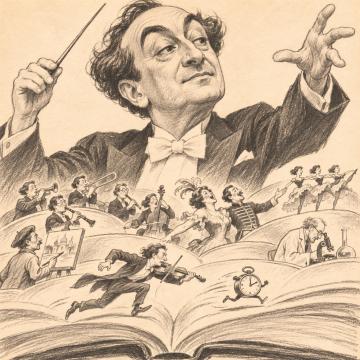
Bernard Grun (Stařeč near Třebíč, 1901 – London, 1972) approached history in a way that invites the reader to look across the page. In The Timetables of History (1975), a political event, a new book, a musical composition and a scientific discovery can all appear in the same row. Grun prepared the English-language chronology from Werner Stein’s Kulturfahrplan, and it was published posthumously.
Before devoting himself to music, Grun studied philosophy and law and earned a doctorate in law. He studied composition with Alban Berg, Egon Wellesz and Hans Gál, and conducting with Felix von Weingartner. He began with chamber music and songs before turning to operetta at Franz Lehár’s encouragement. In the late 1920s he conducted in Karlsruhe and Mannheim, then worked at Vienna’s Komödienhaus theatre.
His stage works include Böhmische Musikanten (1929) and Die Tänzerin Fanny Elßler (1934). He also wrote music for early sound cinema, including Ein Auto und kein Geld (1931). In the mid-1930s he went into exile in Britain and settled in London. He continued to compose there and wrote the operetta Old Chelsea (1942) with the singer and composer Richard Tauber.
Grun returned to musical theatre as a writer. In The Prince of Vienna (1955) he described the life and music of Oscar Straus. He followed it with Kulturgeschichte der Operette (1961) and Gold und Silber. Franz Lehár und seine Welt (1970). These books show readers how operetta lived on the stage and who came to hear it.
He edited and translated the English edition of Alban Berg: Letters to His Wife (1971). The letters take readers into one composer’s private world, while the historical tables offer a view of an entire period. They make it easy to notice what can slip by in a narrative account of history: what was happening in the theatre, in the laboratory or in everyday life at the very same time.
Naslovi u ponudi

Amadeus (Zlatno pero)
Das Leben Wolfgang Amadeus Mozarts aus der Sicht seiner Schwester Nannerl. Ein historischer Roman über musikalisches Genie, familiäre Beziehungen, Liebe und den persönlichen Preis künstlerischen Ruhms.